What Is Arcx
The next generation of robot programming software
ARCx is a cross-platform, browser-based robot programming and control platform developed by Synthiam. It enables hobbyists, educators, researchers, and commercial developers to build intelligent robots without having to program every component from scratch.
ARCx builds on Synthiam's original ARC software, but introduces a fundamentally different architecture designed for modern robotics, embedded computers, AI, and remote operation.
The biggest difference is that ARCx runs directly on the robot while its programming interface runs in a web browser. This allows you to configure, program, monitor, and control a robot from a laptop, tablet, or phone without interrupting its operation.
What makes ARCx different?
Browser-based programming
Access the robot through its IP address using any modern browser. The browser is only the interface; robot processing continues on the host computer even after you disconnect.
Cross-platform operation
Designed for Windows x64, Linux x64, and Linux ARM64, including Raspberry Pi and compatible single-board computers. ARCx can run without a monitor or desktop environment.
Modular Robot Skills
Add capabilities such as computer vision, servo control, speech recognition, navigation, and AI through independent plugins. Skills can be loaded and unloaded while ARCx is running. ARCx's robot skill framework has been enhanced to enable advanced robot skills using machine learning with ONNX, CUDA, and other frameworks.
Integrated AI assistance
Athena, Synthiam's AI assistant, helps users understand, configure, and program robots. It can work with project settings, scripts, variables, and Robot Skills, with approval required for modifications.
Multiple simultaneous connections
Several browsers can interact with the same running robot, making it useful for classrooms, development teams, and remote robotics applications.
How ARCx works
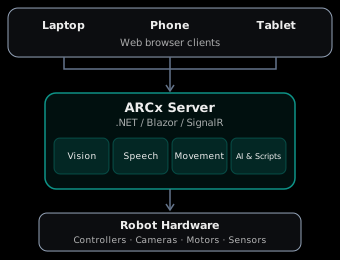
Browsers provide the user interface. ARCx executes robot logic and manages hardware independently.
For example, a Raspberry Pi running ARCx can control a robot's servos, cameras, and sensors. You connect to the Raspberry Pi from your laptop using a browser, configure its behaviors, and then close the laptop. The robot continues operating.
That architecture is particularly valuable for autonomous robots and industrial deployments.
Programming and capabilities
ARCx supports three main programming approaches:
- Blockly: Visual drag-and-drop programming for beginners and education.
- JavaScript: Scripting for robot behaviors, automation, and advanced control.
- Python: Programming for developers who prefer Python.
Robot Skills communicate through ControlCommand(), including commands that return values directly to scripts.
Its broader capabilities include OpenCV-based computer vision, face and color tracking, depth sensing, audio input/output, speech recognition and synthesis, servo control, gait programming, and support for multiple robot controllers.
ARC vs. ARCx
| Feature | ARC | ARCx |
|---|---|---|
| Operating systems | Windows | Windows, Linux, ARM64 |
| Interface | Windows desktop | Web browser |
| Headless operation | Not the primary design | Native |
| Multiple browser clients | No | Yes |
| Robot Skills | Modular plugins | Hot-loadable plugins |
| AI assistant | Yes | Project-integrated Athena |
| Embedded deployment | More limited | Designed for SBCs |
| UI technology | Windows desktop | Blazor |
Technical architecture
ARCx is built around modern .NET technology, with the following architecture:
| Component | Technology |
|---|---|
| Runtime | .NET |
| Web interface | Blazor |
| Live communication | SignalR |
| Plugins | .NET AssemblyLoadContext |
| Computer vision | OpenCV |
| Project security | RSA-based encryption |
| Distribution | Cross-platform executables |
| Default web port | 5000 |
An important architectural decision is separating each Robot Skill's background worker, user interface, and configuration. This allows robot behavior to continue independently of browser interaction.
Development status
ARCx had its first public release in September 2026, and development has continued through October with workspace improvements, depth sensing, and reliability enhancements.
Why ARCx matters
Traditional robot software often requires developers to build separate systems for motor control, sensors, vision, speech, AI, and remote interfaces.
ARCx brings these technologies together in a single extensible environment. Instead of spending weeks integrating libraries, developers can combine existing Robot Skills and focus on the robot's actual behavior.
The long-term value of ARCx is that it makes the computer inside a robot into a remotely programmable, extensible robotics platform. That is useful for everything from a Raspberry Pi-powered hobby robot to a sophisticated humanoid or commercial service robot.
You can learn more at synthiam.com/Products/ARCx.