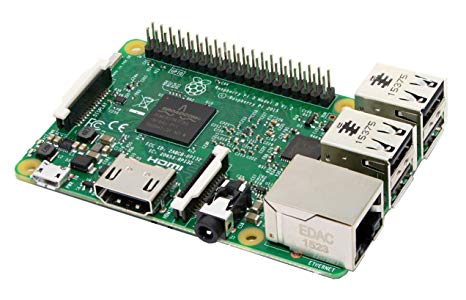
Raspberry Pi by Pi Foundation
Firmware
Turn a Raspberry Pi into an EZ-B V4 server for EZ-Builder: open-source Python, camera support, EZ-Builder connection, hardware precautions.
Turn a Raspberry Pi into an EZ-B to control Pi Camera, GPIO and UART from ARC over LAN/WiFi; supports bi‑directional UART servos.
A Raspberry Pi is a small, affordable computer that can be used as the “brain” of your robot when running Synthiam ARC or when running an EZB Server (which lets ARC connect to the Pi over the network).
There are two common ways to use a Raspberry Pi with ARC:
Option A (Recommended): Run ARC on Windows 11 installed on the Raspberry Pi
Install Windows 11 on a Raspberry Pi 4 (or newer), install ARC, and then use a dedicated robot I/O controller (an “EZB”) such as an Arduino, ESP32, or an EZ-Robot controller for servos and sensors.
Option B: Use the Raspberry Pi as an EZB Server
In this setup, ARC runs on another computer and connects to the Pi over WiFi/Ethernet. The Pi hosts an EZB Server firmware. If you choose this route, select one of the firmware options shown at the top of this page (for example, DJ’s EZBPi or PTP’s Blueberry).
Raspberry Pi onboard I/O is generally not ideal for robotics motion control. Many robots need features like stable servo timing, hardware PWM, ADC (analog inputs), and multiple UART/serial ports. For most robots, you will get a much better experience by using the Pi to run ARC (or to run your robot “brain”) and using an external controller (Arduino/ESP32/EZ-Robot) for the I/O.
Install ARC on Raspberry Pi with Windows 11 (recommended)
You can run ARC directly on a Raspberry Pi by installing Windows 11 for ARM. This is recommended if you want the Pi to be the robot’s main computer (running the ARC project locally).
- Raspberry Pi 4 or newer (Pi 4 is the oldest model that runs Windows properly)
- 8GB RAM minimum (more is better if available)
- External SSD strongly recommended (Windows + ARC on microSD is usually very slow)
While Windows 11 can boot from a microSD card, robot builds are much more enjoyable when booting from a fast drive (SSD or fast USB 3.x flash drive). Slow storage can cause long boot times, laggy UI, and delayed responses.
When running ARC on Windows 11 (on the Pi), connect an external I/O controller (EZB) via USB or WiFi:
- Arduino (common choice for sensors/servos)
- ESP32 (WiFi + I/O, good for distributed robot parts)
- EZ-Robot controller (purpose-built robotics controller)
If you want to boot from a fast USB thumb drive, these models have worked well:
- Samsung 128GB USB 3.1 Flash Drive BAR Plus (MUF-128BE3)
- SanDisk 128GB Extreme PRO USB 3.x Solid State Flash Drive (SDCZ880-128G-G46)
Windows-on-Pi instructions can change over time, so it’s okay to follow the video below and also search for newer guides if something is different on your setup.
- Windows build downloader: https://uup.rg-adguard.net
- Performance/robot setup guide: Tips To Making a Robot
It’s possible to install Windows 11 on a Raspberry Pi without using a separate PC. You can prepare the Windows installer directly from the Pi while it’s running a Debian-based OS (like Raspberry Pi OS) using WoR Flasher by Botspot.
The method shown in the video can install Windows 11 to:
- microSD card (works, but usually slow)
- USB drive (fast USB recommended)
- USB-to-SSD (recommended for the best experience)
- WoR Flasher GitHub: https://github.com/Botspot/wor-flasher
- Install from a PC (alternative guide): https://youtu.be/UYSytYtyqCk
- Raspberry Pi 4 or newer: https://amzn.to/3qBNZCQ
- Optional Raspberry Pi 400 or newer: https://amzn.to/3duZEOi
- Pi CPU cooler (recommended if running heavy workloads): https://amzn.to/3hpmVT0
- 240GB SSD: https://amzn.to/3hpEIti
- SSD to USB adapter: https://amzn.to/3jydp2G
- Optional microSD card: https://amzn.to/3hodXWa
- USB drive: https://amzn.to/364qLvK
Installation Tips & Performance for SBCs
If you are using a Raspberry Pi or any other single-board computer (SBC) in a robot, setup details matter a lot (power, cooling, storage speed, and remote access). Our Support guide includes helpful steps such as freeing storage space, improving performance, powering an SBC reliably, and running “headless” (no monitor/keyboard) using Remote Desktop tools.
View the instructions here: /Support/Tips to Make a Robot/Overview
- Windows 11: Raspberry Pi 4 or newer is recommended.
- EZB Servers: can be run on older Raspberry Pi models, but onboard I/O is still limited for many robotics needs.
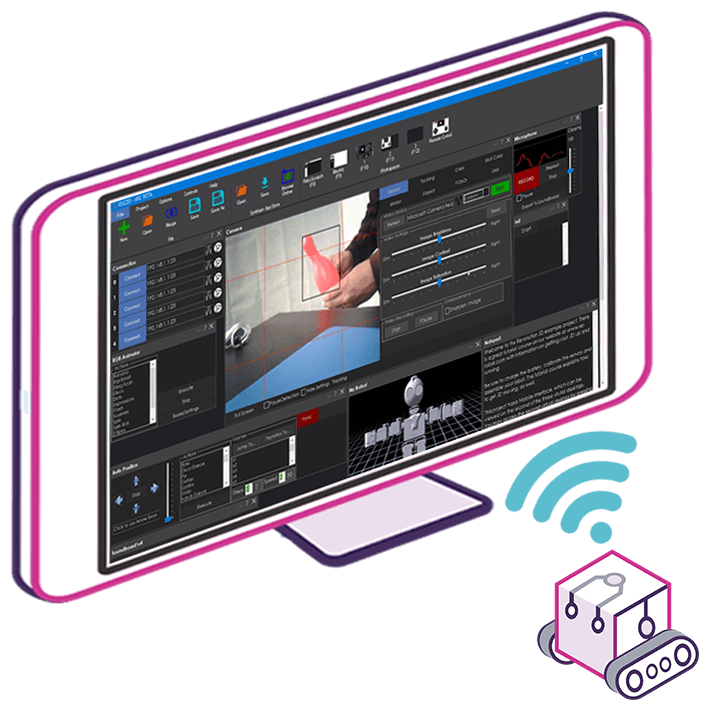
Updated with a new version that broadcasts it's address
:DGreat to see the updating happening,Nice!
Stoked on this!!!
Hello.
I'm trying to get the EZ Pi server running on my Pi and I'm getting the following error. Any help would be greatly appreciated!
Broadcast error. The broadcast service has stopped. Here is why: System.Net.Sockets.SocketException (0x80004005): Access denied at System.Net.Sockets.UdpClient.Connect (System.String hostname, System.Int32 port) [0x001b0] in :0 at System.Net.Sockets.UdpClient..ctor (System.String hostname, System.Int32 port) [0x00044] in :0 at EZBPi.Broadcaster.doSendUDP (System.String str) [0x00001] in :0 at EZBPi.Broadcaster._timer_Elapsed (System.Object sender, System.Timers.ElapsedEventArgs e) [0x00050] in :0
The instructions for launching the pi server requires sudo (root) permission to use certain server features on the OS. Look above at the instructions to launch the pi server and type the same command.
Hello DJ Sures,
Thank you for your quick reply. I have ran the above exactly as the commands on two different pi's with a fresh image three times between them now. Two different places just to make sure something on my network wasn't messing with it and I still get the same error when running sudo mono ./EZBPi.exe. Tried a version 3 and version 2 also, one on ethernet and the other with wifi and ethernet. Once I run the command it shows as it should ( I watched the live hack night as well and made sure to follow each step) and once it hits the part to hit esc to exit, about 5 seconds later the above errors keep going over and over.
Raspberry EZBPi Version: 2019.3.29.0 Verbose logging is: False Serial port is: /dev/serial0 EZB: TCP Started on port 23 EZ-B Server started on TCP Port: 23 Camera: TCP Started on port 24 Camera Server started on TCP Port: 24 Press ESC to quit Broadcast error. The broadcast service has stopped. Here is why: System.Net.Sockets.SocketException (0x80004005): Access denied at System.Net.Sockets.UdpClient.Connect (System.String hostname, System.Int32 port) [0x001b0] in :0 at System.Net.Sockets.UdpClient..ctor (System.String hostname, System.Int32 port) [0x00044] in :0 at EZBPi.Broadcaster.doSendUDP (System.String str) [0x00001] in :0 at EZBPi.Broadcaster._timer_Elapsed (System.Object sender, System.Timers.ElapsedEventArgs e) [0x00050] in :0
This really has me interested. I love to see all the new options and capabilities we are now adding and I am excited about those to come but don’t understand the benefits using Raspberry Pi instead of EZ-Robot micro controller. Please clarify why you would use a Raspberry over a EZ-Robot. I get loading ARC it on Pi as a benefit but not providing PMW has me stumped. I really want to do this but I want to understand the benefits.
Legion, can you do a sudo apt-get upgrade?
also a sudo apt-get update
perhaps the os versions are out dated. Reading the error you posted, the ezbpi cannot bind to the network interface, which is absolutely required for operation.
Ellis, there’s only benefits to those who need it.