

Sketch paths with finger or mouse and set turn/move speeds; interactive, educational demo of timing-based, sensorless robot navigation and limits.
 Windows
How to add the Touch Path robot skill
- Load the most recent release of ARC (Get ARC).
- Press the Project tab from the top menu bar in ARC.
- Press Add Robot Skill from the button ribbon bar in ARC.
- Choose the Remote Control category tab.
- Press the Touch Path icon to add the robot skill to your project.
Don't have a robot yet?
Follow the Getting Started Guide to build a robot and use the Touch Path robot skill.
How to use the Touch Path robot skill
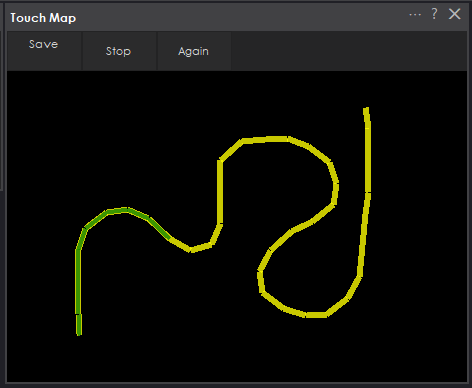
The Touch Path skill lets you “draw” a route and have your robot try to follow it. You can sketch the path with your finger on a touchscreen (tablet) or with your mouse on a computer. This is a fun and easy way to make a robot move without writing any code, and it’s helpful for learning how basic navigation works.
How it works (beginner-friendly explanation)
- You draw a line/path on the screen.
- ARC converts that drawing into a series of basic actions like: turn left/right and drive forward.
- The robot performs those actions using the speed values you set in the configuration menu.
Using Touch Path
- Connect your robot in ARC and confirm you can manually drive it (for example, with an ARC movement panel or your robot’s movement skill).
- Add the Touch Path skill to your ARC project.
-
Open the skill’s Configuration menu and set:
- Movement Speed (how fast the robot drives forward)
- Turning Speed (how fast the robot rotates)
- Draw a simple path first (short lines and gentle turns). Then try longer or more complex routes once you see how your robot reacts.
Configuration tips (important for beginners)
- Every robot is different. The best movement/turning speed settings depend on your robot’s size, motor power, battery level, and surface (carpet vs. tile).
- Start slow. Lower speeds usually track a drawn path more smoothly and reduce wheel slip.
- Test and adjust. If your robot overshoots turns, lower the turning speed. If it travels too far, lower the movement speed.
Accuracy and limitations (why it may not follow the path perfectly)
Touch Path does not measure real distance traveled. It relies on timing—meaning ARC tells the robot “drive for this long” or “turn for this long.” In real life, robots rarely move exactly the same every time.
- Wheel slippage (especially on smooth floors) can cause drifting.
- Battery level can change speed (a low battery often moves slower).
- Surface changes (carpet, thresholds, uneven flooring) affect distance and turning.
- No encoder feedback means the robot can’t “correct” itself if it veers off course.
Why this skill is still worth using
Even though it isn’t meant for precision navigation, Touch Path is a great learning tool. It demonstrates early “dead reckoning” style navigation (timed movement) and helps you understand why modern robots use mapping, localization, and sensor-based navigation for reliable results.


Related Questions
Touch Path Driving With Sabertooth
Touch Path Overshoot On Sphero Turns
Upgrade to ARC Pro
Unleash your robot's full potential with the cutting-edge features and intuitive programming offered by Synthiam ARC Pro.
This looks like it will be very useful. On the 2024 list to learn.