
Screen Resolution & Display Issues
This document includes details on recommended display resolution and on diagnosing blurriness in Synthiam ARC in Microsoft Windows. Scroll through this document to identify the section that is relevant to your experience.
Proper screen resolution and Windows scaling settings are critical for getting the best experience when using Synthiam ARC. Incorrect scaling can reduce usable workspace, force the use of scrollbars, and make complex robot projects harder to manage.
Minimum and Recommended Display Settings
The minimum supported screen resolution for ARC is 1024×768 with Windows scaling set to 100%. While ARC will run at this resolution, workspace will be limited, and many robot skills may require scrolling.
The recommended resolution for comfortable daily use is 1920×1080 (1080p) or higher at 100% scaling. This provides adequate space for multiple robot skills, configuration panels, and real-time feedback windows.
On 4K (3840×2160) displays, Windows scaling is often required to keep text readable. In these cases, a scaling value of 150% or 175% is typically sufficient. Be aware that increasing the scaling enlarges text and buttons, reducing the available screen space for robot skills.
Higher scaling values trade usable workspace for readability. If your monitor is physically large, running at 100% scaling may still be comfortable and will provide the maximum workspace.
Understanding Resolution Scaling in Windows
Microsoft Windows includes a feature called display scaling that adjusts the size of text, apps, and other interface elements independently of the screen resolution. This directly affects how ARC’s interface is displayed.
When scaling is set above the recommended range (typically 100–125% for non-4K displays), Windows enlarges UI elements, reducing available screen real estate. In ARC, this results in:
- Less room for robot skills and panels
- More frequent use of scrollbars
- Reduced visibility of multiple skills at once
For best results, Windows scaling should be set to the lowest comfortable value for your display.
How to Adjust Screen Scaling
Step 1
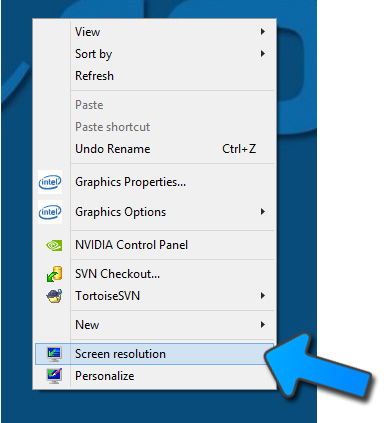
Right-click on an empty area of your desktop to open the context menu. Select Display settings (or Screen resolution on older versions of Windows).
Step 2
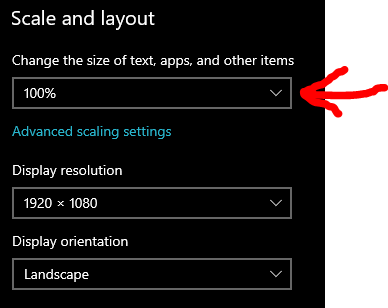
Locate the Scale and layout option, which controls the size of text, apps, and other on-screen elements. Choose a reasonable scaling value:
- 100% – Recommended for 1080p and lower resolutions
- 125% – Acceptable for higher-resolution displays if text is too small
- 150%–175% – Common for 4K displays
After changing scaling, close and restart ARC to ensure the interface updates correctly.
Best Practices
- Use 100% scaling whenever possible for maximum workspace
- Avoid custom scaling values that Windows does not list
- Restart ARC after any scaling or resolution change
- Balance readability and workspace based on monitor size, not just resolution
Correct resolution and scaling settings ensure ARC remains sharp, readable, and efficient when building and controlling robots.
ARC Appears Blurry on 4K Displays
If Synthiam ARC looks blurry or slightly out of focus on a 4K or high-DPI display, this is not a bug in ARC itself. The issue is caused by how Microsoft Windows handles display scaling for desktop applications.
Why This Happens
Windows was initially designed around 96 DPI displays (commonly 1080p at typical monitor sizes). When 4K displays became common, Microsoft added display scaling to make text and UI elements readable. Unfortunately, this system was bolted on after the fact and behaves inconsistently across applications.
Many desktop applications (including complex, high-performance tools like ARC) render their UI at a fixed resolution. When Windows applies scaling on top of that rendering, it often uses bitmap upscaling instead of accurate DPI-aware rendering. The result is a soft or blurry appearance, especially noticeable on text, icons, and fine UI details.
Custom scaling values (anything other than the standard 100%, 125%, 150%, etc.) make this problem worse. In many cases, Windows applies a second scaling pass, further degrading visual clarity.
Recommended Fix: Enable “Fix Scaling for Apps”
Windows includes an option that attempts to correct blurry desktop applications by re-evaluating how scaling is applied. While not perfect, this option often improves clarity for ARC and other desktop software.
How to Enable It
- Open Windows Settings
- Go to System
- Select Display
- Scroll down and click Advanced scaling settings
-
Under Fix scaling for apps, turn on:
“Let Windows try to fix apps so they’re not blurry.” - Close and restart ARC.
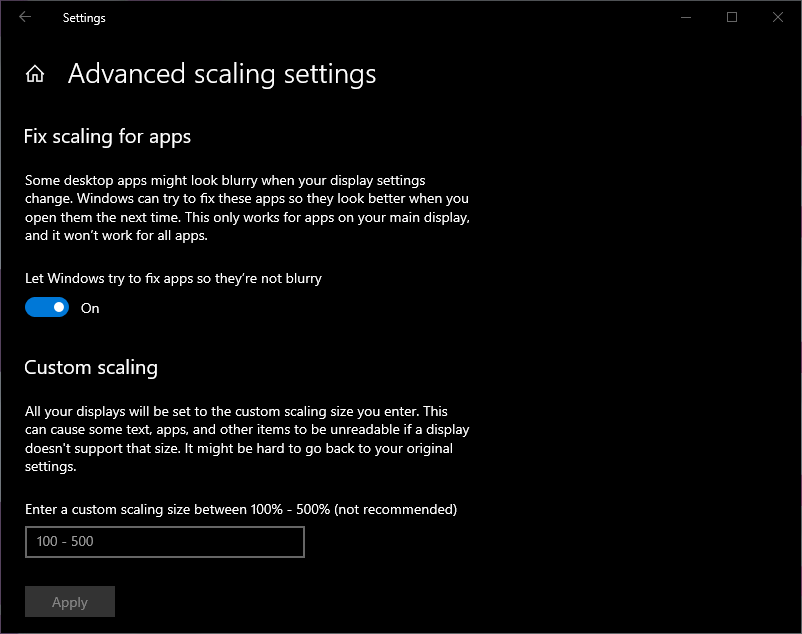
This setting only applies to desktop applications and primarily affects the main display. It may not fix every app, but it is the first and easiest step to try.
Additional Suggestions
Option 1: Set Scaling to 100%
The most precise results are achieved when Windows scaling is set to 100%. This disables DPI scaling entirely and allows ARC to render at native pixel resolution.
If text and UI elements appear too small at 100% scaling, consider the resolution option below.
Option 2: Run the Display at 1080p
Many users find the best balance of clarity and usability by running their monitor at 1920×1080 with scaling set to 100%.
This avoids Windows scaling altogether and provides crisp, predictable rendering. On large 4K monitors, 1080p at 100% scaling is often more comfortable than 4K with aggressive scaling.
Option 3: Avoid Custom Scaling Values
Custom scaling (for example 110%, 135%, or 175%) is not recommended. These values frequently cause Windows to fall back to bitmap scaling, resulting in blurring.
Stick to standard scaling values or use 100% scaling whenever possible.
Summary
- ARC is not blurry by design; the issue is caused by Windows DPI scaling
- 4K displays expose weaknesses in Windows’ scaling implementation
- Enable “Fix scaling for apps” in Advanced Scaling Settings
- For best clarity, use 100% scaling or run the display at 1080p
- Avoid custom scaling percentages
These steps provide the most reliable way to achieve sharp, readable visuals when running Synthiam ARC on high-resolution displays.