
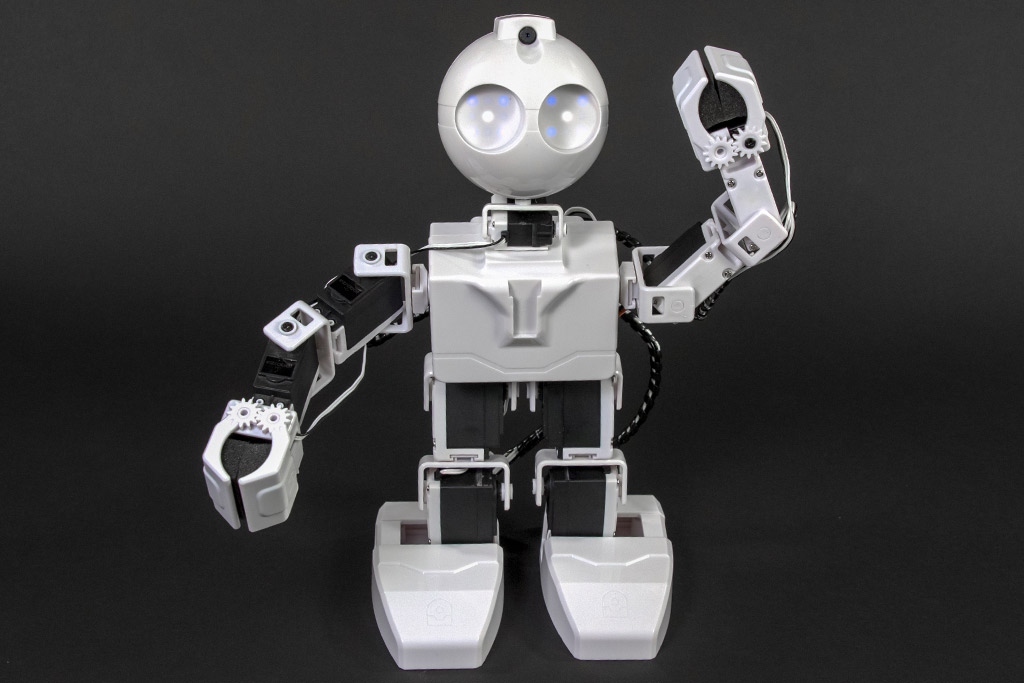
JD Humanoid by EZ-Robot


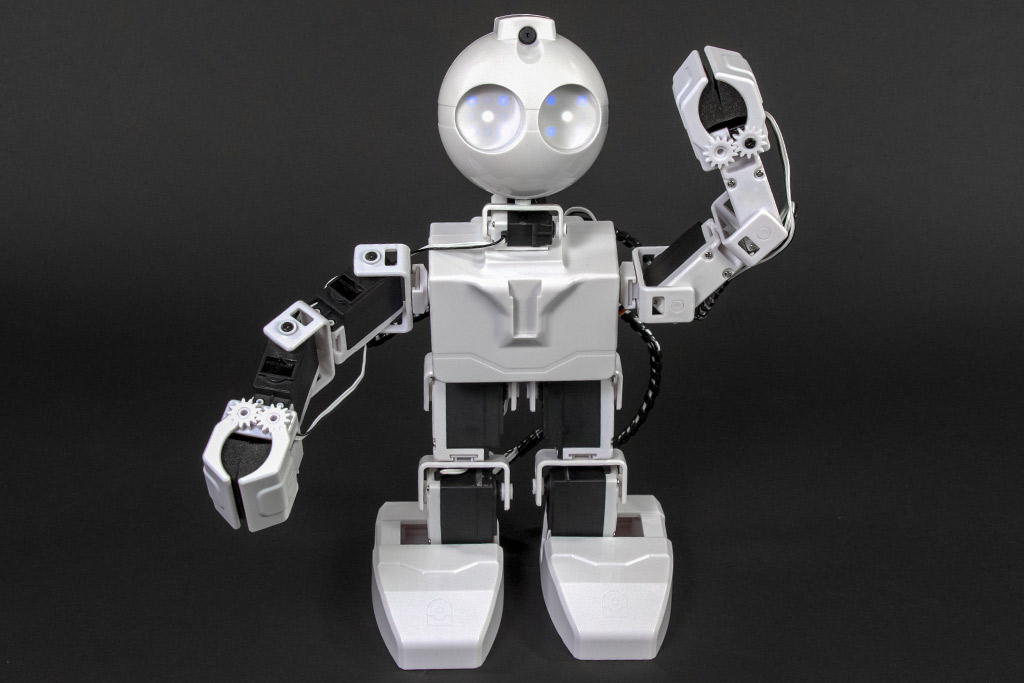
A humanoid that waves, dances and talks
JD is EZ-Robot's 16-joint humanoid robot kit, built around an EZ-B v4 controller with a camera in its head and LED eyes. In Synthiam ARCx you pose JD and save the poses as animations, record performances, walk it with a joystick, and give it a voice and vision, all from a web browser.
How JD works with Synthiam. JD's controller is an EZ-B v4, which runs EZB firmware out of the box. ARCx connects to it over Wi-Fi with the Ezb Connection robot skill. Then Auto Position (movement Panel) turns poses into gestures and walking, and every other ARCx skill (camera, speech, AI, Custom UI) works with JD straight away. We recommend ARCx: it runs on Windows, Linux and Raspberry Pi and is used from any web browser. ARC, Synthiam's Windows application, works with JD too.
What is JD Humanoid?
JD is a ready-to-build humanoid robot kit from EZ-Robot, originally invented in Canada. It is designed for people who are brand new to robotics and want a robot that is fun to build, easy to control and educational.
- 16 degrees of freedom (DOF): 16 joints that move independently, across the arms, legs and head.
- Metal-gear, heavy-duty servos: the motors that move each joint. Metal gears are stronger and more durable than plastic ones.
- Grippers for hands, a camera in the head and LED eyes that can show expressions.
- EZ-Bits construction: modular parts designed to fit together easily, which keeps the build simple for beginners.
- EZ-B v4 controller with Wi-Fi and a built-in speaker, plus a LiPo battery and charger.
JD at a glance
| Type | Humanoid robot kit |
|---|---|
| Maker | EZ-Robot |
| Controller | EZ-B v4 (EZB firmware) |
| Joints | 16 DOF, metal-gear servos |
| Head | Camera and LED eyes |
| Audio | Speaker built into the EZ-B v4 |
| Connection | Wi-Fi (USB/serial possible, see the EZ-B v4 page) |
| Power | LiPo battery in the torso, balancer charger included |
| Size | 15 × 13 × 33 cm, 1.33 kg |
| Synthiam uses it for | Gestures, dances, walking, vision, speech, AI, teaching |
| Website | ez-robot.com |
Beginner tip: most of robotics is “connect and test”. Build a section, connect its servos, then test the movement before moving on. This catches problems early, such as a servo turning the wrong way or a loose connection.
What you can do with JD in Synthiam
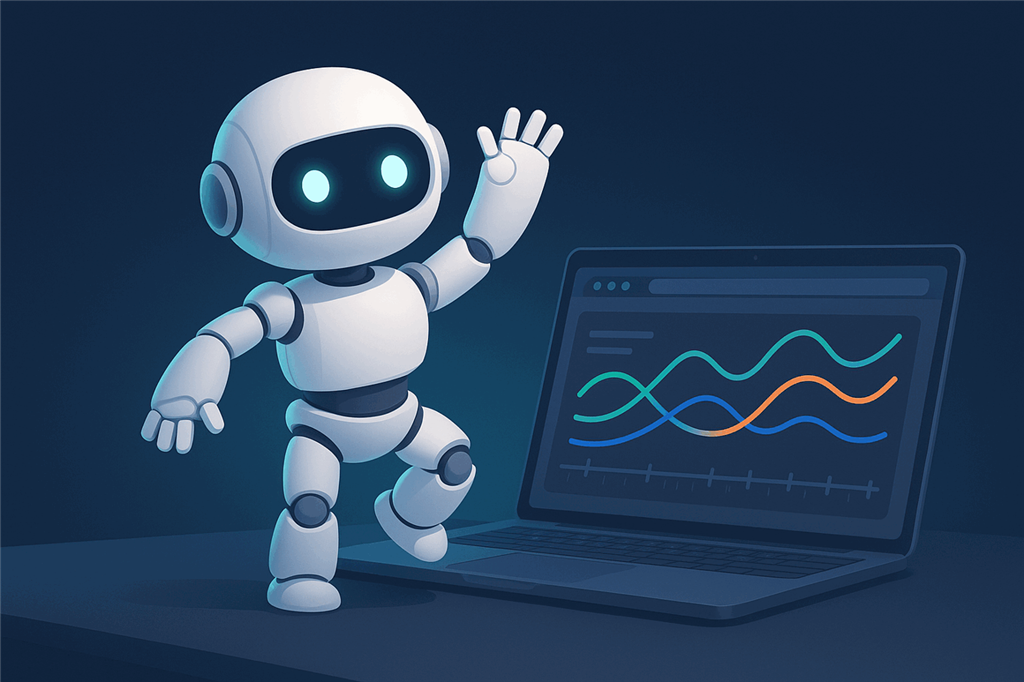
A humanoid is all about movement. Synthiam gives you three ways to make JD move, from simple to expressive, and they all work together with speech, vision and AI.
- Auto Position: pose JD, capture each pose as a frame, and string frames into named actions like Wave, Bow or Dance.
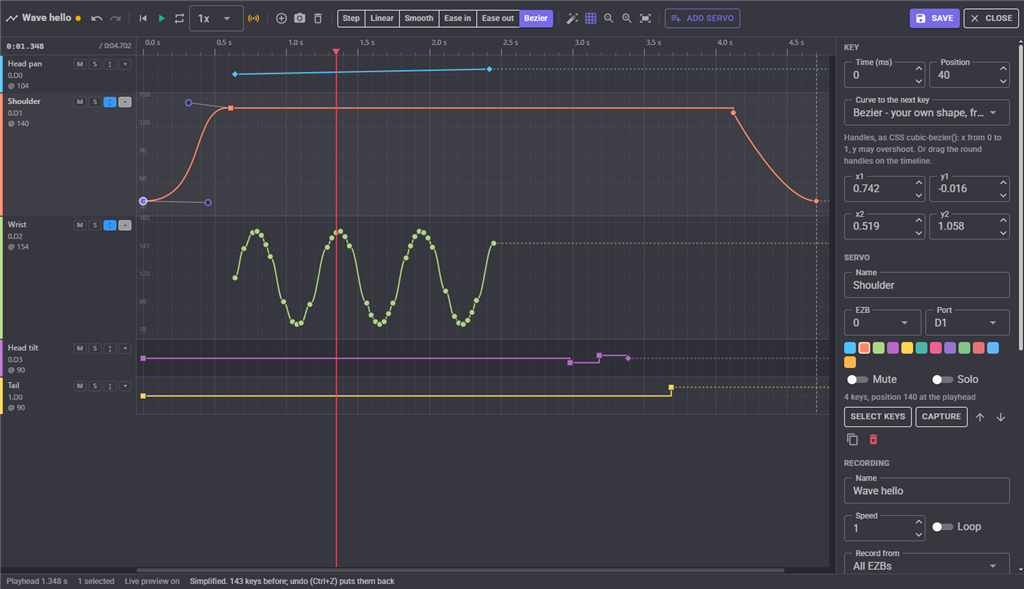
- Servo Animation: record JD's servos as they move, then polish the performance on a timeline with music and sound effects.
- Servo Pad: puppeteer the head or an arm by dragging a finger across a pad, and save favorite positions as poses.
Gestures and dances
Auto Position (movement Panel) plays named actions with smooth transitions, set per step with delay, steps and ramp. Run them from a button, a script, a voice command or an AI.
Walking
Auto Position (movement Panel) reserves Forward, Reverse, Left, Right and Stop actions. Fill them with gait frames and the Movement Joystick, a gamepad or a script walks JD like it would drive a wheeled robot.
Performances
Servo Animation records whatever moves the servos, then lets you edit every joint as a curve, add script points that speak, and line it all up with WAV or MP3 audio lanes.
Puppeteering
Servo Pad drives the head's pan and tilt (or an arm) from a touch pad, with smoothing, saved poses and recorded takes.
Eyes and vision
Camera Source (ezb) streams the head camera. Face Tracking, Color Tracking and Glyph Recognition find things; Vision Detection Tracking Script turns JD's head to follow them.
Expressive LED eyes
Rgb Eyes Animator builds color animations for EZ-Robot's RGB eyes module, frame by frame, and plays them by name: Happy, Angry, Blink.
Voice
Text to speech plays through the EZ-B v4's speaker when Project audio is set to the EZB. Speech Phrase Recognition turns spoken commands into actions.
AI conversation
Autonomous AI, Chat GPT and Aimlbot let JD hold a conversation and run its actions. ARCx is also an MCP server for agents like Claude.
What you need to use JD
A computer
To run ARCx: a Windows 10/11 PC, an Ubuntu 24.04 computer, or a Raspberry Pi 4/5 running Ubuntu 24.04. Then use JD from any browser. ARC needs a Windows PC.
Wi-Fi
Either connect directly to the robot's own Wi-Fi network, or put the EZ-B v4 on your home network.
Enough power
Servos draw a lot of current, especially when many joints move at once, like walking. Always use the recommended, fully charged battery to avoid brownouts (random resets) and weak movement.
Connect JD to ARCx
- Build JD from the EZ-Bits parts and connect each servo to the EZ-B v4, following EZ-Robot's build guide. Test as you go.
- Power on and join the robot's Wi-Fi. Out of the box the EZ-B v4 makes its own Wi-Fi network (AP mode). Connect the computer that will run ARCx to it. The EZ-B v4 page explains how to switch to your home network instead.
- Install ARCx and open it in a web browser. Download ARCx.
-
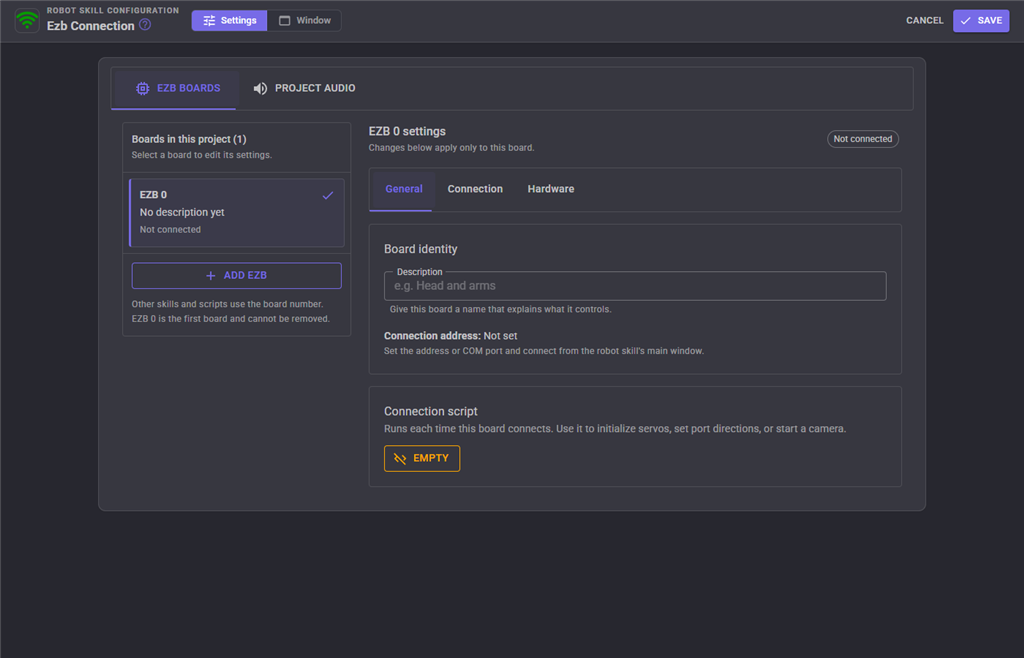
Connect. Add Ezb Connection (Communication category), pick JD from the address list
or type the address, and press the green connect button. In AP mode the address is normally:
192.168.1.1 - Check every servo. Add Auto Position (movement Panel) and add JD's 16 servos on its Servos tab with their ports and limits. With Realtime update on, move each slider gently to confirm it moves the right joint in the right direction. Invert a servo on the Servos tab if it runs backwards.
- Create a first action. Pose JD standing, press Capture and name the frame Stand. Pose an arm up for a Wave frame, then build a Wave action that moves Stand, Wave, Stand. Press Execute.
- Add the head camera. Add Camera Source (ezb), pick the camera and press Start. Save the project.
Already have a JD project in ARC?
Auto Position in ARCx can import an Auto Position configuration from an ARC project file on its Import/Export Utilities tab. Actions named Forward, Reverse, Left, Right and Stop become the walking actions, so frames and gaits you built in ARC carry over.
Using ARC instead?
Connect with ARC's EZB Connection and animate JD with Auto Position Movement Panel (Gait), Servo Recorder and RGB Animator.
Both work, ARCx is recommended
JD works with both of Synthiam's robot programming platforms, because both speak the EZ-B v4's EZB protocol. If you are starting today, choose ARCx.
| ARCx Recommended | ARC | |
|---|---|---|
| Runs on | Windows 10/11 x64, Ubuntu 24.04 x64 and ARM64, Raspberry Pi (Ubuntu 24.04) | Windows |
| User interface | Any web browser: laptop, tablet or phone, several people at once | Windows desktop application |
| Animation tools | Auto Position, Servo Animation timeline editor with audio lanes, Servo Pad | Auto Position, Servo Recorder, Servo Pad |
| AI agents through MCP | Yes | No |
| Connection skill | Ezb Connection | EZB Connection |
Troubleshooting
- Make sure the computer running ARCx is on JD's Wi-Fi network (AP mode) or on the same network JD joined (client mode).
- If JD does not appear in the address list, type the address by hand. On Windows the scanner only works when that network is set to Private.
- In AP mode the computer has no internet; that is normal. Cloud speech and AI skills need a second connection (Ethernet or the USB Wi-Fi dongle in the box), or put the EZ-B v4 on your home network.
The EZ-B v4 uses two circuit boards that work together during start-up. The top board holds the communication processor and Wi-Fi antenna. The bottom board holds the I/O processor, which handles hardware functions such as port control and the start-up sound. At power on, the communication processor starts first and sends start-up commands to the I/O processor; once the I/O processor answers, the EZ-B finishes starting up and plays the start-up sound.
No start-up sound usually does not mean the speaker is broken. More often it is a sign that the I/O processor is not responding. During connection, the communication processor accepts the connection and performs the first part of the EZB handshake, then hands over to the I/O processor, which must return its firmware ID. If the connection log stops at the firmware ID request and no ID comes back, the I/O processor is not responding, which strongly suggests the bottom board is damaged.
The camera may still work, because the top board's communication processor handles the video stream. A working camera only proves the top board is alive, not that the whole EZ-B is healthy.
The usual cause is electrical damage to the I/O system: ports that were shorted, overloaded, or given too much voltage or current. The EZ-B v4's I/O protection has limits and cannot prevent all damage.
Frequently asked questions
Teach JD its first dance
Install ARCx, connect with Ezb Connection, and turn poses into gestures, walks and performances from any browser.
@athena app asks to change preferences
If the Synthiam ARC app on your iPad is prompting you to change preferences, it may be referring to settings within the app or your iPad's system settings that need to be adjusted for optimal performance or connectivity. Here's what you can do:
Check App Permissions: Ensure that the Synthiam ARC app has the necessary permissions to access your iPad's features like Wi-Fi and Bluetooth. You can check this in the iPad's Settings under the app's name.
Wi-Fi and Bluetooth: Make sure that your Wi-Fi and Bluetooth are turned on, as these may be required for connecting to your robot.
Network Settings: If the app is asking to change network preferences, it might be because your robot needs to be on the same Wi-Fi network as your iPad. Connect both devices to the same network.
App Settings: Within the Synthiam ARC app, there may be specific settings that need to be configured. Look for a settings icon or menu within the app to adjust preferences as needed.
Follow Prompts: If the app is giving you specific instructions or prompts to change preferences, follow those instructions carefully.
Update App: Make sure you have the latest version of the Synthiam ARC app installed. Updates can fix bugs and improve compatibility.
Restart App: Close the Synthiam ARC app completely and reopen it to see if the issue persists.
Restart iPad: Sometimes, simply restarting your iPad can resolve unexpected issues with apps.
If you continue to have trouble or if the app's prompts are not clear, you can visit the support section on the Synthiam website for more detailed guidance: https://synthiam.com/Support.