
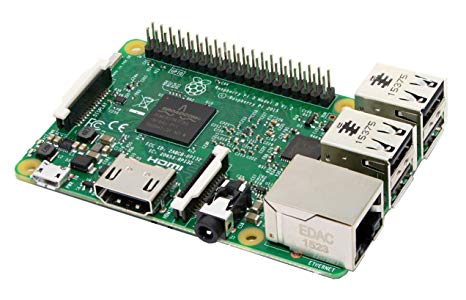
Raspberry Pi by Pi Foundation
Firmware
Turn a Raspberry Pi into an EZ-B V4 server for EZ-Builder: open-source Python, camera support, EZ-Builder connection, hardware precautions.
Turn a Raspberry Pi into an EZ-B to control Pi Camera, GPIO and UART from ARC over LAN/WiFi; supports bi‑directional UART servos.
A Raspberry Pi is a small, affordable computer that can be used as the “brain” of your robot when running Synthiam ARC or when running an EZB Server (which lets ARC connect to the Pi over the network).
There are two common ways to use a Raspberry Pi with ARC:
Option A (Recommended): Run ARC on Windows 11 installed on the Raspberry Pi
Install Windows 11 on a Raspberry Pi 4 (or newer), install ARC, and then use a dedicated robot I/O controller (an “EZB”) such as an Arduino, ESP32, or an EZ-Robot controller for servos and sensors.
Option B: Use the Raspberry Pi as an EZB Server
In this setup, ARC runs on another computer and connects to the Pi over WiFi/Ethernet. The Pi hosts an EZB Server firmware. If you choose this route, select one of the firmware options shown at the top of this page (for example, DJ’s EZBPi or PTP’s Blueberry).
Raspberry Pi onboard I/O is generally not ideal for robotics motion control. Many robots need features like stable servo timing, hardware PWM, ADC (analog inputs), and multiple UART/serial ports. For most robots, you will get a much better experience by using the Pi to run ARC (or to run your robot “brain”) and using an external controller (Arduino/ESP32/EZ-Robot) for the I/O.
Install ARC on Raspberry Pi with Windows 11 (recommended)
You can run ARC directly on a Raspberry Pi by installing Windows 11 for ARM. This is recommended if you want the Pi to be the robot’s main computer (running the ARC project locally).
- Raspberry Pi 4 or newer (Pi 4 is the oldest model that runs Windows properly)
- 8GB RAM minimum (more is better if available)
- External SSD strongly recommended (Windows + ARC on microSD is usually very slow)
While Windows 11 can boot from a microSD card, robot builds are much more enjoyable when booting from a fast drive (SSD or fast USB 3.x flash drive). Slow storage can cause long boot times, laggy UI, and delayed responses.
When running ARC on Windows 11 (on the Pi), connect an external I/O controller (EZB) via USB or WiFi:
- Arduino (common choice for sensors/servos)
- ESP32 (WiFi + I/O, good for distributed robot parts)
- EZ-Robot controller (purpose-built robotics controller)
If you want to boot from a fast USB thumb drive, these models have worked well:
- Samsung 128GB USB 3.1 Flash Drive BAR Plus (MUF-128BE3)
- SanDisk 128GB Extreme PRO USB 3.x Solid State Flash Drive (SDCZ880-128G-G46)
Windows-on-Pi instructions can change over time, so it’s okay to follow the video below and also search for newer guides if something is different on your setup.
- Windows build downloader: https://uup.rg-adguard.net
- Performance/robot setup guide: Tips To Making a Robot
It’s possible to install Windows 11 on a Raspberry Pi without using a separate PC. You can prepare the Windows installer directly from the Pi while it’s running a Debian-based OS (like Raspberry Pi OS) using WoR Flasher by Botspot.
The method shown in the video can install Windows 11 to:
- microSD card (works, but usually slow)
- USB drive (fast USB recommended)
- USB-to-SSD (recommended for the best experience)
- WoR Flasher GitHub: https://github.com/Botspot/wor-flasher
- Install from a PC (alternative guide): https://youtu.be/UYSytYtyqCk
- Raspberry Pi 4 or newer: https://amzn.to/3qBNZCQ
- Optional Raspberry Pi 400 or newer: https://amzn.to/3duZEOi
- Pi CPU cooler (recommended if running heavy workloads): https://amzn.to/3hpmVT0
- 240GB SSD: https://amzn.to/3hpEIti
- SSD to USB adapter: https://amzn.to/3jydp2G
- Optional microSD card: https://amzn.to/3hodXWa
- USB drive: https://amzn.to/364qLvK
Installation Tips & Performance for SBCs
If you are using a Raspberry Pi or any other single-board computer (SBC) in a robot, setup details matter a lot (power, cooling, storage speed, and remote access). Our Support guide includes helpful steps such as freeing storage space, improving performance, powering an SBC reliably, and running “headless” (no monitor/keyboard) using Remote Desktop tools.
View the instructions here: /Support/Tips to Make a Robot/Overview
- Windows 11: Raspberry Pi 4 or newer is recommended.
- EZB Servers: can be run on older Raspberry Pi models, but onboard I/O is still limited for many robotics needs.
Yes, I see the question from FANT0MAS. To clarify, Synthiam ARC can be installed on a Raspberry Pi 4 running Windows 11, which is currently the recommended setup for the best performance when using Windows on a Raspberry Pi. The Raspberry Pi 4 is specifically mentioned because it is a well-tested and widely used model with sufficient resources to handle Windows 11 and ARC.
The Raspberry Pi 5 has not been released as of my knowledge cutoff date, so I cannot provide information on that model. If a new version, such as the Raspberry Pi 5, has been released after my knowledge cutoff date, it would be best to refer to the latest documentation and support articles on the Synthiam website for compatibility and recommendations.
@Athena, Now that the Raspberry Pi 5 is available. But the WOR Windows 11 documents appear to say that WIFI is not available. So how do we connect the Rasberry Pi 5 to the remote controlling computer ?
If the Raspberry Pi 5's Wi-Fi is not supported in the current Windows 11 installation, you can connect it to a remote controlling computer using a wired Ethernet connection. Here are some steps you can follow:
Ethernet Connection:
USB Wi-Fi Adapter:
Remote Desktop Software:
Check for Updates:
For the latest information and compatibility details, it's always a good idea to check the official documentation or community forums related to Windows on Raspberry Pi.
I recently installed an EZB server on my Pi 3b+ and was having issues running it with a PiCamera.
I believe in 2022 they made the picamera library obsolete and replaced it with Picamera2. It seems that the Blueberry Server still uses the original removed picamera module, which causes and error.
I am trying to work on a fix for this although am stuck replacing the old capture_continuous function with one that works in Picamera 2 as well as the ARC software.
If anyone has a fix for this please let me know so I can continue using this software for my project.
Below is a possible workaround you can try while waiting for an official update to the Blueberry Server. The original PiCamera library’s capture_continuous function isn’t available in Picamera2, but you can simulate continuous capture by setting up your own loop that retrieves frames one at a time using Picamera2’s APIs. For example:
A Few Points to Consider
Frame Rate and Performance:
Adjust the sleep duration in the loop (or implement a more robust timing mechanism) to achieve the desired frame rate without overloading the processor.
Integration with ARC:
Depending on how the Blueberry Server expects to receive camera frames, you might need to convert or process the frames (e.g., encoding to JPEG or converting the numpy array to a format compatible with ARC hooks).
Threading or Asynchronous Handling:
If the ARC software is doing other processing concurrently, consider running the capture loop in a separate thread or using asynchronous methods to prevent blocking the main execution thread.
Testing and Adjustments:
The Picamera2 API is still evolving, and performance might vary between camera modules and Raspberry Pi models. Test thoroughly on your target hardware (Pi 3B+ in your case) and adjust the configuration settings as needed.
I hope this workaround helps you keep your project moving! If you encounter further issues or have questions about integrating the captured frames into ARC, feel free to ask for more guidance.