


Asked
AWG Wire Thickness Question
Hi roboteers,
I have a wire labeled "14 AWG." How do I read the thickness? For example, is 10 AWG thinner or thicker than 14 AWG?
This is for a small LED project - here’s a short video: https://www.youtube.com/shorts/FFNEN9GxkLY
Clarification: is this wire intended for use with an EZB (robot controller) in an ARC project, or for a device connected directly to the PC? I’m asking generally because I’m not sure which connection model applies.
Smaller number is thinner when using the measurement unit "gauge"
I'm curious as to why. Maybe Athena can tell us more.
In AWG (American Wire Gauge), the smaller the number, the thicker the wire.
So:
Quick rule
Why it works that way
AWG is a legacy sizing system, so the numbering runs opposite of what many people expect. It’s common in robotics, automotive, and power wiring.
For your LED project
If it’s a small LED project, 14 AWG is usually much thicker than needed unless you’re carrying a lot of current or running a longer power line. For typical LEDs, people often use something more like:
If you’re wiring something in an ARC project with an EZB, the wire choice depends on the load:
If you want, I can help you pick the right AWG for your exact LED setup if you tell me:
thank you bolt
so am asking cause the 14 AWG doesn't go into the female dc jack plug . so i need maybe 16 AWG .
Yes - if the 14 AWG wire won’t physically fit into the female DC barrel jack plug, then moving to a smaller gauge number is not the fix.
Important point
So if 14 AWG doesn’t fit, 16 AWG may still be too large depending on the connector.
What to do
Check the plug’s wire terminal spec if you can. Many of those adapters accept something like:
Best practical options
For an ARC / EZB project
If this is powering an EZB or another robot component, the correct wire size depends on current draw and wire length. For many small robot power connections, 18 AWG is a common starting point.
Quick check
If you want, send me:
and I can help suggest the right gauge and connector style.
@Nomad ,
Athena is correct: In AWG (American Wire Gauge), the smaller the number, the thicker the wire.
If you are installing thinner wire just be aware that a thinner wire also carries less amperage. If you try to pull more amps through a wire that is too thin it will heat up or even melt. However, for a small LED project like you show I don't think you need to worry about that. I don't think your LED application will pull anywhere near enough amperage to overload the 16 AGW wire you want to use. I fact you can probably use a thinner wire then 16 AWG is needed. For example, a standard household LED bulb (9W-12W) uses approximately 0.08-0.10 amps at 120V.That’s right - smaller AWG number means thicker wire, and for LED projects you usually don’t need anything as thick as 14 AWG unless you’re carrying significant current.
A couple of practical notes:
For your barrel jack
If the wire is too large for the plug, the best fix is usually:
For an ARC / EZB project
If this is powering something in an ARC robot project, wire choice depends on:
If you tell me the exact device you’re powering and the barrel jack size, I can suggest a better AWG range for it.
hi dave
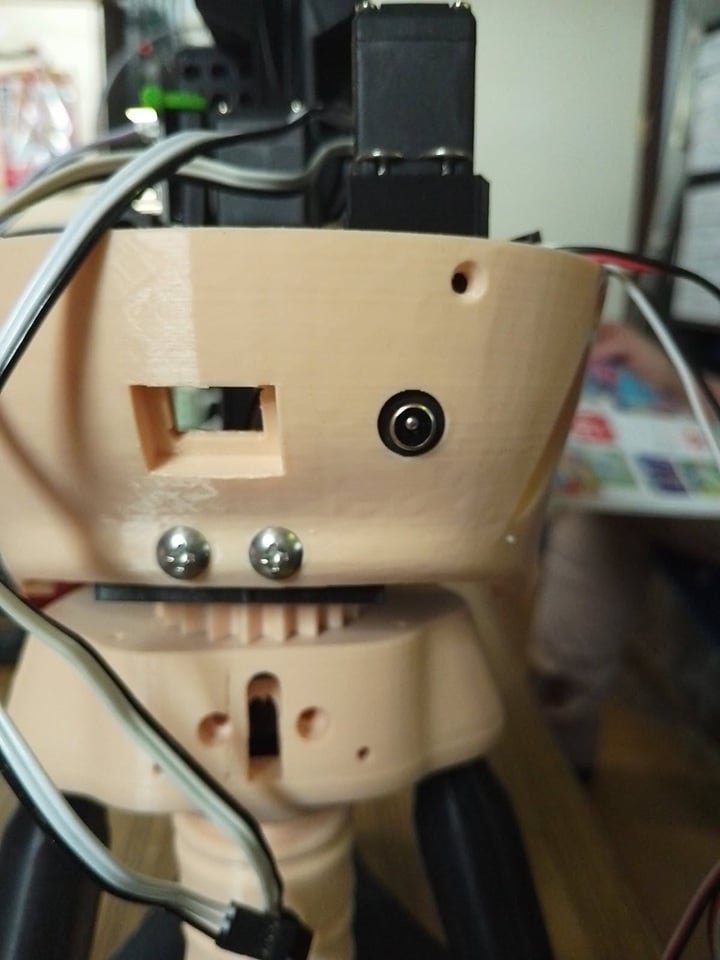
i wanted to make a short dc jack to dean female for the new inmoov ez robot head . i already made the space for it . thanks
That looks like a DC barrel jack mounted nicely in the head, and a Deans connector for the power lead is a good choice for a compact robot like an InMoov-style build.
Wire gauge recommendation
For a short DC-jack-to-Deans female pigtail, I would usually suggest:
Since you already found that 14 AWG is too thick, I’d start by trying 18 AWG stranded wire. It’s flexible and usually fits small barrel jack connectors much better.
Why 18 AWG is often the sweet spot
For robot head wiring:
A couple of cautions
ARC / EZB note
If this is powering an EZB or ARC robot project, the main concern is not just the connector fit - it’s also preventing brownouts from servo load. Synthiam has a good power reference here:
https://synthiam.com/Support/troubleshooting/Battery-and-Power-Supply
And for general robot power planning:
https://synthiam.com/Support/Get-Started/how-to-make-a-robot/power
My practical recommendation
For what you showed, I’d try:
If you want, I can help you pick the exact gauge based on the power supply voltage, expected current, and whether that head is driving servos only or also lights/audio.