




Asked
— Edited
Ez Robot At Intel Idf16
As in tomorrow? Fellas a little heads up on these huge announcements.. I would have flown down to see this!
 Single Camera Servo Server
— TCP video server for Unity clients to stream camera video and send servo positions to ARC for remote robot control
Try it →
Single Camera Servo Server
— TCP video server for Unity clients to stream camera video and send servo positions to ARC for remote robot control
Try it →
As in tomorrow? Fellas a little heads up on these huge announcements.. I would have flown down to see this!
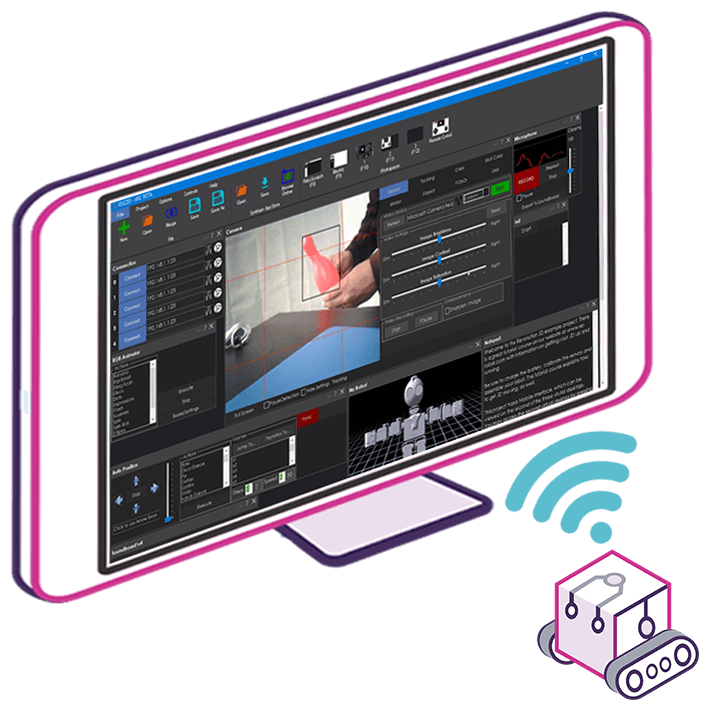
Check the specs of the joule - it is an atom as well.
Here's a link from the our news feed: https://newsroom.intel.com/newsroom/wp-content/uploads/sites/11/2016/08/intel-joule-fact-sheet.pdf
..that is strange...BTW @JD did a higher resolution camera get developed? If so will it be released in this next batch of bits?
With embedded pcs, there's no need for ezrobot to invest effort to create a new camera when there's an infinite selection of USB cameras. Also, ezrobot will be looking into Intel real sense cameras shortly - no timeline. There's lots of stuff in the hopper at the moment and we want to get that out onto the store first.
Ok great to know! Makes a lot of since, I believe it was a year ago or more that I remembered seeing post. Technology moves faster then concepts!
Went to a mall and Intel had set up a "booth" where they showed off the camera and several different uses for the technology. I wonder if it uses the same TOF time of flight technology that the Kinect uses.
Edit just looked it up...uses pretty much the same tech as the prime sense (discontinued) camera I used for my motion capture video. Uses TOF, projector IR
It seems the dream last then a year....
INTEL DISCONTINUES JOULE, GALILEO, AND EDISON PRODUCT LINES
https://hackaday.com/2017/06/19/intel-discontinues-joule-galileo-and-edison-product-lines/
https://www.electronicdesign.com/embedded-revolution/intel-amputate-three-modules-internet-things-including-joule
it seems small & cheap arm boards are the long term options.
It'll still happen, with a PC onboard... someday. There's no immediate need for it today. It just won't happen with Intel - or, maybe it will with ATOM? Intel seems to be moving away from IoT, which is a smart move considering ARM has a significant market share. I don't think anyone can compete with ARM for distributed low cost processing.
Intel lost the CPU race recently to AMD, only because Intel will be late to the market. AMD isn't focusing on server application, which won't hurt Intel very much. Intel is incredibly strong in server CPU, and I don't think anyone can take that away from them.
Intel's core focus in the late 70's and early 80's was promoting hobbyist and inventors with their products. That department (MIG) is being dismantled it appears. It's a shame, because they did make pretty big bad decisions for their MIG focus. I stand by my observation that Intel dropped the ball on engaging and supporting the correct startups - plus, their infrastructure is so large that low cost products don't keep the lights on. Intel would have to streamline to operate as effective as ARM, which means significant layoffs and that would play havoc with their investors.
Other companies, such as Broadcom, ST Micro, etc. have historically only offered low cost products. So their infrastructure was built to be supported by low cost offerings. That is the opposite of Intel, who's infrastructure evolved from high cost cpu sales. This positions other chip manufacturers (Broadcom, STM) to still licence ARM and sell low cost without affecting their infrastructure. x86 isn't more expensive to manufacturer, it's the Intel's infrastructure that can't support lowing the cost of it.
This thread that you replied to is a great example. EZ-Robot was the only product ready to ship which included a Joule. We did put a great deal of effort to work with Intel to include the Joule in an EZ-Robot. Their pushback came in logistic and pricing challenges. Also, there was absolutely zero support from the Intel contacts we had. Email replies with simple requests would take 7-10 days. Even today, when we talk to Intel it can take weeks for a response. Most departments don't respond to us at all anymore.
EZ-Robot's tech is so advanced and unique, it steps on a lot of toes. Specifically for those who have made investments in less capable technologies. That doesn't mean we're going to apologize for being better.
Either way, the more these companies turn their back to EZ-Robot's direction, the more room they make for us to succeed.