





Asked
— Edited
Arcx Release And Questions
I just discovered this thread and read a bit more about ArcX. https://synthiam.com/Community/Questions/Smooth-start-of-the-servo-movements-when-starting-ARC-22019.
I have a few questions based on that discussion.
- Is ARCX being released this month? (March)(beta?)
- What's ARCX's upgrade pricing plan? 3) If ARCX is beta and all robot skills won't be ported until June/July when will the pricing be in place?
- Will there be a Perpetual License version?
- Are there plans for legacy ARC support? If so for how long?
- Will legacy ARC continue to be subscription based? 6) ARCX is web-based. Will all robots with ArcX need to be connected to function?
Thanks in advance. Will

My question was only for general information. I currently use Linux on two other PCs and my interest is mainly to avoid Windows if possible. There is nothing specific missing for me in ARC at the moment; I was simply curious about the status of ARC X.
Oh ya - don’t get me started about windows haha. I’d like to avoid it at all costs if possible as soon as possible.
To dig deeper on my previous response about maturing opensource. The expanded version is I’m hoping to see improvements on how the projects are managed and updated etc.. There are many many opensource projects with wonderful support for commercial or enterprise use. But the rest are generally "shoot from the hip" management style. Breaking changes, untested merges, missing dependencies, and most commonly is installation/build difficulty. This usually is because the dependencies to build or use a library could be unique to a specific district/use case.
With windows, it’s heavy because it has backward compatibility and simple library/assembly installation etc.
linux is more of a forward compatible os - if such title existed.
that’s gonna change eventually. And I think it will. Until then, as a Linux user, you know there’s no such thing as a "generic Linux program".
We can also add some development/performance experience to complement what DJ is saying. It was under Synthiam's original assumption that Linux outperforms Windows, which we have realized is false. The assumption was that Windows is resource-hungry with too many services and dependencies. Ironically, Windows GUI outperforms Linux. This is because Windows automatically enables GPU acceleration, and the frameworks have been optimized for decades. Linux apps use different stacks, GTK, Qt, X11, Wayland, etc., and they involve extra layers (App -> Toolkit -> Display server -> Compositor -> GPU, etc). Because of Linux's layered architecture, GUI operations can incur slightly more overhead.
We get excited about Raspberry Pis and other single-board hobbyist computers. The downfall of Windows is RAM usage, until... You run XServer on Linux for a desktop experience. Suddenly, there are as many resources and services running as Windows, AND it's using as much RAM, plus its GUI is slower.
Synthiam had experimented with Linux ARC several years ago - if you were around for it. It worked with many missing features because some things just weren't available, such as speech recognition and webview embedding. That's when Windows ARM became compatible with those same single-board computers, and we decided to focus ARC development efforts on Windows rather than split between Linux/Windows.
ARCx looked promising at the start (almost 3 years ago now). The architecture was to run OS agnostic and require a web browser for the GUI. That actually ended up being a good idea, and we have a product being developed for education that uses that approach. The main problem with ARCx was the lack of libraries to support functions such as a basic speech recognition system. Not everything revolves around it - but that's the simplest benchmark. Once there's an accessible/reusable speech recognition that works across distros, etc, ARCx might be revisited. Until then, ARCx would require dozens of third-party subscriptions for basic functionality.
You're probably scratching your head, wondering "how can this be?"... "how can the entire world be split into a Windows and a mismatched Linux tech space?" Those are very good questions that we discuss often. How can there not be a competitor to Windows - and how can there not be a Linux distro competitor to Windows?
My take is that someone needs to spin up a Linux distro that costs money and turn its support into a business, kind of like what Red Hat did for enterprise. If Windows costs money to purchase, why can't an "easy, reliable, working Linux distro" cost half as much? We need that - and that's when open source projects will be inspired to mature their process, specifically if the developers can get paid for their effort.
If this new Linux Distro were to pay the developers of libraries used in the Distro, then those developers of open-source projects could suddenly quit their day jobs and focus on maintaining the projects. Right now, open-source projects are maintained in one's spare time - some get even less attention than that.
Yah, it’s mind boggling how limited technology is because of Linux / Windows being the only two options.
One is written in spare time by people with jobs, and those employers most likely ironically use windows.
And the other is written by people who don’t really know how to program
Not really a good choice no matter which direction you choose
That makes sense. The Linux ecosystem can be quite fragmented.ROS is a good example. It runs mainly on Linux and is extremely powerful, but it’s also quite complex to use. You really need to know Linux well and be comfortable programming in Python or C++. That’s one of the reasons tools like ARC are so appealing for hobbyists.It really lowers the barrier to getting started with robotics.
Just curios... if ARCx is to be web based, will that mean it needs to be connected to the internet at all times to work? hopefully not
No - it means it uses a webbrowser for the UI. So, rather than it being an application, it can be accessed remotely from another computer. However, that's similar to using ARC with tightvnc or remote desktop.
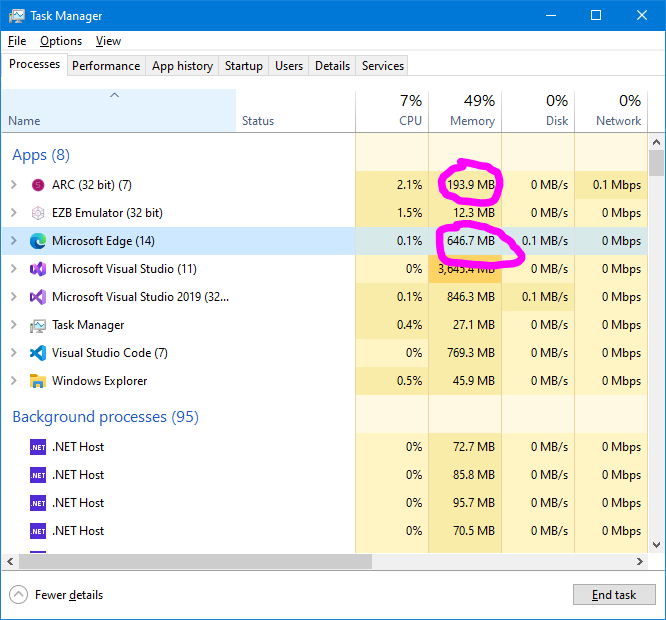
It's a little clunky to be programming in a webbrowser, doesn't feel natural. Also, webbrowsers use a TON of ram, and running a program in the webbrowser doesn't do any favors to RAM usage. I mean, look at this... ARC with a full running project is using 193MB and Edge is using 646MB and the only website I have open is Synthiam as i write this message.
With Ram prices as high as they are, web browsers need to be less system hogs! haha