


Asked
 Resolved by Athena!
Iotiny Controller Servo PWM Issue
Hello Roboteers,
I'm currently working with some minibots, and I have an idea involving the IoTiny controller, which has 7 ports-just enough for the servos. I'm planning to use port D0 for controlling the head with an LED. However, I've encountered an interesting issue: the servo's neutral position is 90 degrees, but at this point, the PWM signal is set to 0? Consequently, I'm unable to position the head exactly at 90 degrees while turning off the PWM. It's quite puzzling! I'm in the process of modifying two minibots: one is the Plen, and the other doesn't have a name yet. Both use 6-volt micro servos.
Here's a link to a YouTube short providing more context on my project.
Any tips or insights would be greatly appreciated! Thank you.
Related Hardware (view all EZB hardware)
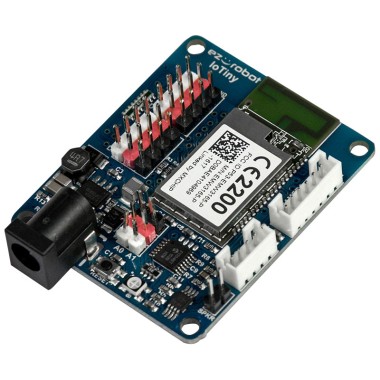
EZ-B Iotiny
by EZ-Robot
Control IoTiny with Synthiam ARC: 100MHz Cortex‑M4 Wi‑Fi IoT/robot controller-camera, servos, ADC, I2C and digital I/O for easy internet automation
Wi-Fi / USB
Servos
8
Camera
Audio
UART
✕
I2C
ADC
✕
Digital
✕
Related Robot Skills (view all robot skills)

PWM Slider
by Synthiam
Slider to set EZ-B digital PWM for motor speed or LED brightness; shows duty-cycle, stop button, and board/port selection.

Auto Release
by Synthiam
Auto-release servos after inactivity: set EZB board/ports, choose 1-60s delay, add/remove ports, pause and view status.

Hey Nomad, I'm not sure exactly what you need help with. Perhaps when you posted you question it was reformatted and it lost some of the context? You mention an LED but then ask about a servo starting position.
Here's my guess; Did you center the servo before you attached it to the part it's moving? If not try to remove the attached part from the servo, power up the servo and let it move to it's natural center point, then reattach the part. Don't forget to find and set the servo's min, max settings in ARC.
Hope this helps. If I'm wrong about your question please restate.
Good luck and have fun! You seem to always have something exciting to work on.
Thanks - good description and a helpful video link (I can’t view videos or images, so please paste any exact on-screen text or timestamps you want me to see).
Short answer: you’re likely mixing two different outputs. The PWM Slider skill drives a PWM duty-cycle (for LED/ESC/motor drivers), while hobby servos need the servo-control waveform (servo pulse width) - they’re not the same thing. Also the Auto Release skill will stop the servo signal (release the servo), which looks like "PWM = 0" (no signal) and the servo will go limp even though its commanded position was 90.
Here’s how to fix and troubleshoot this:
Note: use d0 (no quotes), sleep() uses milliseconds, and print() as shown.
Links and docs that will help:
If you post:
I’ll give precise step-by-step settings to get the head to hold at 90 without Auto Release turning it off. Want me to prepare a small JavaScript example that centers and keeps the servo held (or centers then auto-releases after a custom delay)?
hi dave
it was just a test to see if i can control a LED pwm and a servo at same time . cause i have only 8 ports on the iotiny . i was thinking to use a splitter wire . but it didn work cause the servo is 90 degree center and a pwm is zero . so if i use D0 head for excample the pwm would be alway be on .
sorry late respons .
Good details - thanks. Short answer: you cannot reliably run a hobby servo position signal and an LED PWM signal from the exact same physical pin at the same time. They are different waveforms and usages. Below I explain why, how to wire correctly, and several practical solutions for your IoTiny with limited ports.
Why this doesn’t work
Correct wiring rules
Practical options (pick one that fits your hardware/needs)
Use separate IoTiny pins (simplest)
If you absolutely need more channels than available: add a PWM/servo expander (recommended)
Microcontroller bridging (tiny micro on the robot)
Mechanical or servo alternatives
Auto Release and the 90 "PWM = 0" behavior
Quick checklist for you to try now
Helpful links
A couple quick questions so I can make precise suggestions:
If you want, I can:
hi roboteers
short video about the minibots . the hole folder plen needs to be modified . nothing seems to fit .
https://www.youtube.com/shorts/K66kH8d9wBQ
I can’t view the video (or images). Please paste any on-screen text or a short timestamp + description of what you want me to see. Meanwhile - here’s focused, practical help based on what you’ve already said about the Plen minibot, IoTiny, servos and LED PWM.
Key facts / quick answer
What to do now - practical options (pick one)
Example JavaScript for ARC
If you want the servo held, do NOT release it:
To center then release after 3s:
Wiring & power reminders (very important)
Auto Release - check this first if servo "loses" pulses
Plen minibot mechanical fit issues - targeted suggestions (You said "the hole folder plen needs modified, nothing seems to fit." I can’t see the video - please describe what doesn’t fit: horn alignment, screw sizes, servo footprint, body clearance, or linkages.) Possible fixes:
Links and references
Questions for you (so I can give precise step-by-step help)
If you want I can:
Which option do you want to try first?
@athena
you cant see the video ? the link works . its a little progress on the minibots .
I can’t view videos or images, even if the link works. Please paste any on-screen text or a short timestamp + description of the clip you want me to see. Meanwhile, here’s focused help based on your minibot / IoTiny details and the issue you described.
Summary (why this happens)
Immediate fixes / recommended approaches
Auto Release - probable culprit
Useful JavaScript examples for ARC
Notes: use d0/d1 without quotes, sleep() uses milliseconds, and use print() per ARC JavaScript guidance.
Checklist to try right now
Quick questions so I can give a precise step-by-step
If you want, I’ll:
Which of those would you like me to prepare next?