



I Am Itchin' To Get Started
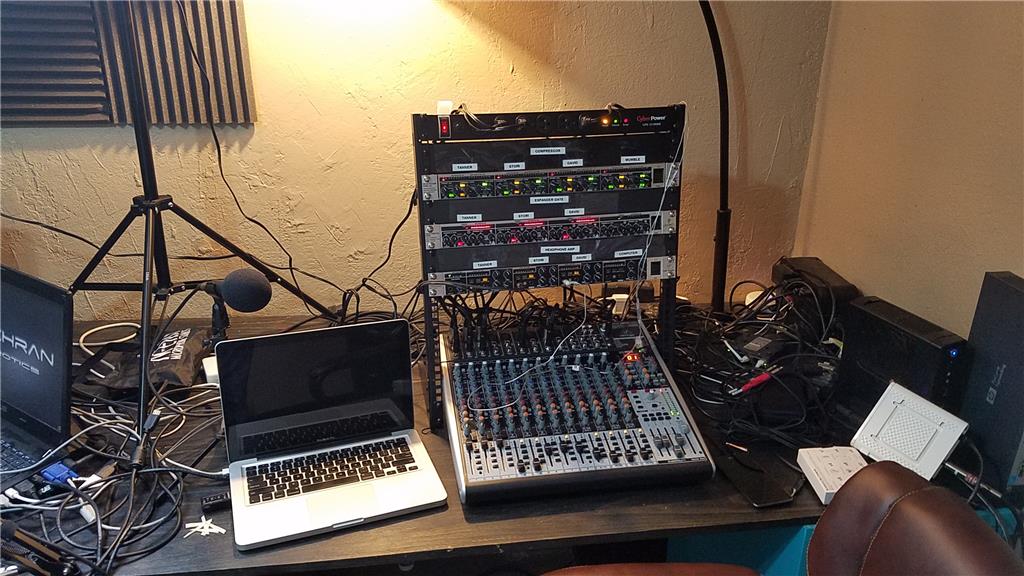
A while ago I had mentioned that I would be starting a video podcast that functions as technical classes for homeschool students. I had also mentioned that I would go all in if I did it. Well, I went all in. My office has been converted to a video podcaster's paradise. Last weekend I was able to get the mixer, compressor, gate, Audio interface, green screen, dynamic mics, cameras, lighting and sound dispersion panels installed in my studio. My hosts (Tanner and Stori) both have a JD now and are learning about them by going through the LMS curriculum that was developed. We will start some "test" shows on Thursday evenings which will help the hosts to be more comfortable in front of the camera and allow them to get really comfortable with the robots and the technology behind the video podcast. The podcasts will be live so you will get to see all of the fun if you want to
On another project, I have been working with a group in the middle of nowhere Texas that is setting up a ranch for people who have aged out of the foster care system in Texas. Next week I will be setting up their firewall, NAS, domain server, some workstations, network and such. They will be using the class mentioned above for their students to teach them about robotics on the EZ-Robot platform. I want to do a show from the ranch but the logistics could make that difficult.
I will post the links to the video podcast streams later. We will be streaming on Youtube and Twitch. We also will have the RTMP feed available to be viewed directly. We have a mumble room and IRC channel that I will publish also. These allow participation in the discussion that is happening and in the show. Along with that, 662-4ROBOT1 is a direct phone number into the show, and Skype is also available. If you want to check out our early tests, I will post the links later. The official start is on May 6th 2017. We will be broadcasting from our booth at a Homeschool show in Oklahoma City.
I want to also do a show on Saturdays on more generic topics but all relating to technology. Nicholas (my son) will be teaching an Intro to Programming class. The next semester we will move up to intermediate programming and robotics classes.
SM@RT Club is the Patreon support page for the classes. I still have some work to do on it, but it is there at least.
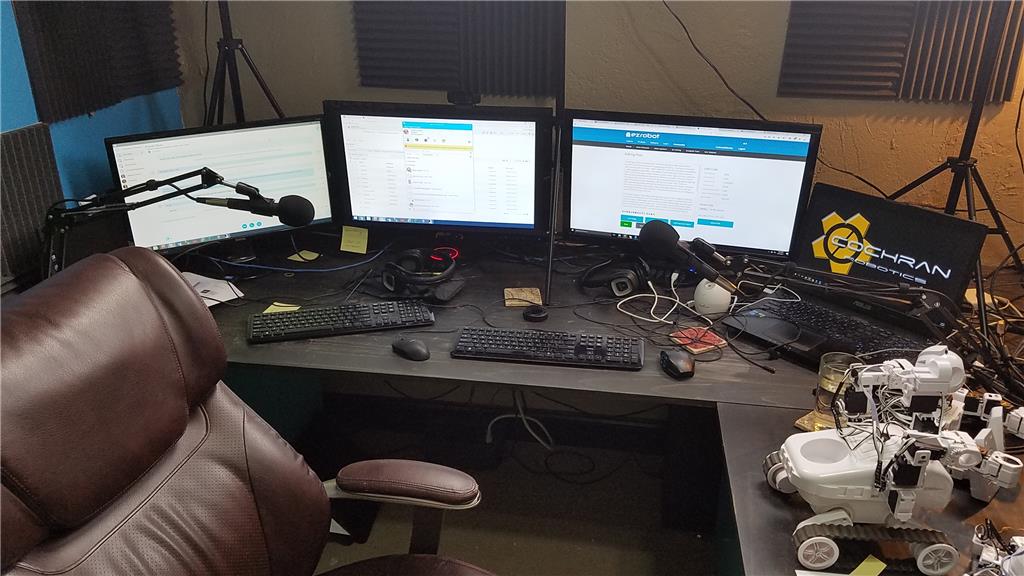
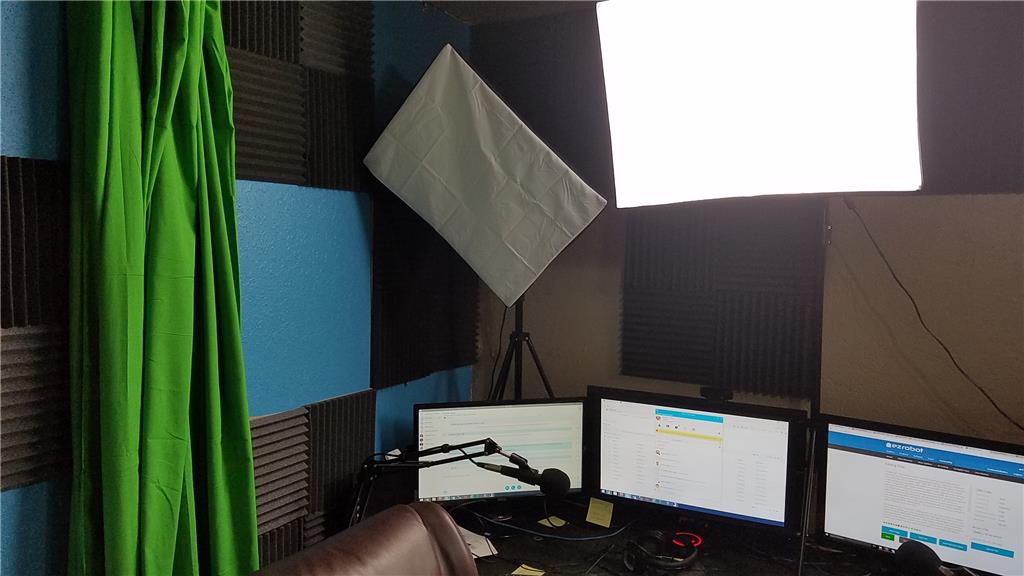
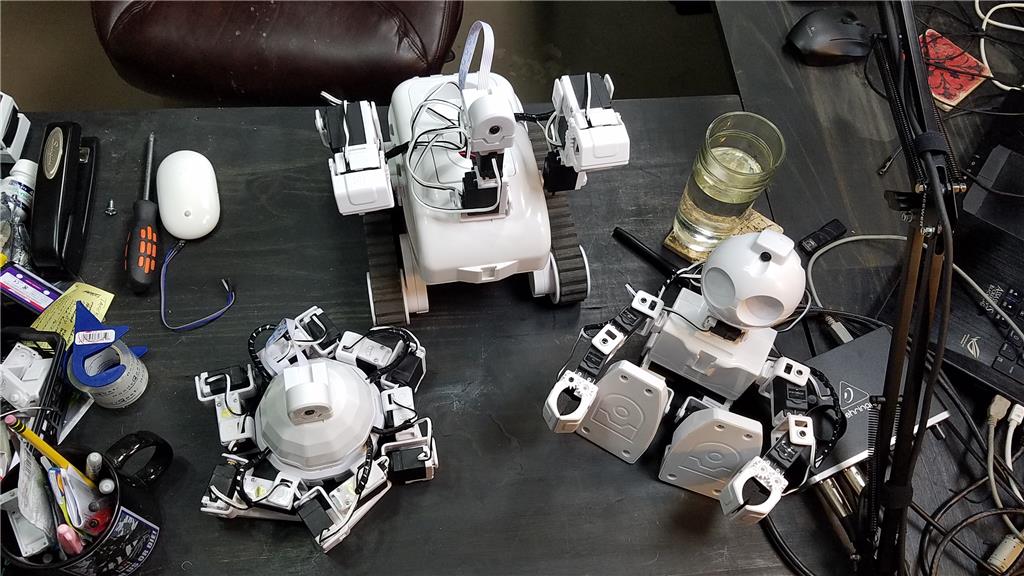
I guess I still need to clean up some cables...
Can see great things coming from this show, but yes it sounds as though you have too many others things going on to be able to put 100% creative input into your show along with everything else.
I'm looking forward to seeing the people here displaying their robots on your show and basically giving us a run down of how,why and when it all happened, etc.
It could turn out to be something great..before you know it you'll have people show casing their ez-robots from all over the world on your show.
Hey David...something off topic
I managed to get API.AI going, I am still working on it...but it seems to be a very good way to integrate your own personal assistant to drive an EZ-Robot! Once I get this done I will put a YouTube clip together!
But also I discovered something today which might be very interesting! I do not want to feature other companies hardware here on the forum, so I did not start a new topic, but this thing here seems to be very interesting!
https://aiyprojects.withgoogle.com/
There was some talk on how to integrate an always on mic to your robot project, also I guess API.AI could be integrated easy...
I look forward to seeing what you have done with API.AI. A really cool thing about API.AI is that you are able to save your work in a zip and then others can import that work preventing them from having to start from scratch.
I saw the aiyproject. It is pretty cool. It would be pretty simple to incorporate into a robot due to the button simply closing a loop which could be done by attaching an EZ-B controller to it via a digital pin. It is what I have been wanting to do with an echo dot for a while but haven't been able to find the time to focus on it yet.
I don't know that I would use an always on mic to trigger this device. I would use the speech recognition built into the ARC app to have a phrase that set a digital pin to high or low which duplicates the press of the button. From there you would be able to do something like "[Robot Name], I want to ask you something" as the phrase.
The largest issue that I see with the product is that linux doesn't have a great speech recognition engine. There are a couple of options, but none of them are great. This is what we ran into with the EZ-AI project. We ended up recording the text and passing it off to nuance and then sent the information to API.AI. API.AI does have a speech recognition engine that is fairly good. They were looking at ways to improve it while we were working with them which would have allowed us to bypass the nuance engine.
Another option is that Nuance is building an API.AI type application. This allows speech to be used by Nuance and things to happen on a single platform until you want detailed information like "What is Lisinopril?" For something like that you would be best converting the audio to text and then sending it to Wolfram|Alpha.
Anyway, for the cost of the aiyproject, it wouldn't be a bad first step.
All of our logic layer was written in Java. We haven't taken the time to convert it to C# yet. It is on my list of things to get to but it may be a while before this happens. Once there, it can be setup to run through plugins instead of through a central computer type device. I know that java works on windows and all, but it just doesn't make sense to leave it in Java instead of using ARCs plugin model.
great video's ,aldo i dont understand it i do learn a little,
@Mickey666Maus,
Related to the solution you mentioned: https://synthiam.com/Community/Questions/10342
I got it mainly due to the Voice HAT.
The Kit has 2 MEMs microphone, amplifier circuit, GPIO (PWM) generated sound, and filter.
the price is cheaper than build a similar Voice HAT.
It's a good opportunity to study the google solution and possible integrations.
Pure curiosity.
@ptp Good to see you got this going already...I really try to keep up with all the stuff going on here at the forum, but I guess I missed that one! Awesome value!
@CochranRobotics I also tried to make a plugin for ARC but I am far from being good enough to script! The documentation provided in the tutprial is also fairly bad! I was able fix the error caused by the wrong .net framework but the could not compile even after I targeted ARC as reference for compiling! How to build a plugin would be a great thing for the Technology Today show!
My Api.Ai project is also briged to ARC by Java Script, and if we are using Google Chrome we are hands on a superior voice recognition...everyone has a browser in Windows and will be able to run Java, so maybe the plugin is obsolete anyways!
But a plugin for ARC would be welcome since all the handy stuff like voice commands is so EZ to integrate!
https://www.google.com/intl/en/chrome/demos/speech.html
Hey guys, this morning I realized it will take some time until I will be putting up a YouTube clip, since I am just too slow in getting this type of stuff done...I am also still kind of in the middle even getting my robot for the testing environment ready!
So I thought to pace things up a little I will just upload a working version of the script to my serverspace for you to test it out... it is just a simple bot with the native smalltalk agent, no training whatsoever!
The only thing I did to bridge it with ARC is to add a httpGet(theUrl) fuction after the respond(spokenResponse) funtion which sends the variable that is returned by the query within the action parameter, in this case it would be smalltalk.greetings or smalltalk.greetings.hello etc , over to the server to trigger a command for the robot!
I DO NOT claim any credits for the script, I found it on github, the link is provided over at the general discussion on api.ai here in the forum!
https://synthiam.com/Community/Questions/10330
What I am still trying to accomplish would be getting data into api.ai...eg to store data lets say via IFTT MakerWebhooks to the server in a correct format so the fullfiment in api.ai will be able to read the data correctly. Any information on this would be highly appreciared!
I uploaded the code for testing, and could also leave it there if we would decide to collaborate in building and agent, or just as a testing enviroment!
https://www.downtown-tattoo.de/robotics/test123.html
edit same problem on the link...please remove https and put http to your browsers address bar...
Building a plugin is a part of our intermediate programming class. Now is as good of a time as any to outline our classes I suppose for everyone here. The classes are 5 months long for the first and second year. They move to 10 months long in the 3rd and 4th year. These classes are $25 per student per month per class and are available as long as the student is paying for the class. There is a Learning Management System for each class that tests the students on what they know and also gives us an idea of if the class as a whole is understanding the material. Most of our classes consist of 1 hour of lecture, 1 hour of Q&A, a homework assignment which is then reviewed and graded and a quiz per week.
Classes will be available online along with the LMS. We only speak English so everything is in English. Students can participate in the live classroom discussions or decide to watch the class on their schedule. Assignments will be assigned for that week at the end of the lecture. The student has five days to complete the assignment from the time that it is given an then take a quiz. The assignments are reviewed and discussed during the Q&A section of the lecture. This not only teaches the student in the lecture, but the skills are reinforced four times throughout the week. This is the best way to learn new things and is practiced by our classes.
I have these classes broken down into 4 years (matching high school years in the US). Some classes can be taken concurrently. For example, a student can take the Intro to Programming and Intro to Robotics classes concurrently and then the Intermediate Programming and Intermediate Robotics classes concurrently. This allows them to complete the first two years of education in one. A student may decide to take the 3D modeling and Printing class along with the Advanced Programming class, and then take both classes of the fourth year together. It is up to the abilities of the student. A student can have all of our classes taken in 30 months if they choose to do so. The classes are college level classes with the final classes being equal to graduate level classes. These classes are not limited to high school students. We have a 55 year old lady enrolled in our programming classes because it is something that she always wanted to learn.
Year One The first year the student can take Intro to Robotics and Intro to Programming.
-The intro to robotics class covers from what is digital vs analog, Amps and Volts, Batteries and power sources, Regulating power, Building and fine tuning your robot, ARC controls and what is available in them, the example projects and how they work, Blocky and Scratch scripts and ends with an into to scripting.
Year Two
Intermediate programming which is where we switch to C#. In this class students use the information above and the ARC SDK to learn how to write plugins. There are more in-depth topics like multi-threading, interfacing with the EZ-B and other topics.
Intermediate Robotics takes what has been learned from the above classes and goes indepth into scripting and building plugins for use with the ARC product.
Year Three The student can decide to break off and focus on programming or do the robotics classes, or both.
For the robotics track, we spend time on 3D Modeling and Design using Autodesk products. We already have our trainer relationship setup with Autodesk. We also cover maintenance and use of a 3D printer.
For the programming track we go into more advanced topics like socket programming, abstract data types, polymorphism, and many more higher order applicative techniques.
Year Four
The robot track is about designing, building and programming a robot design that is designed and created by the student. The student will design and build a robot using the skills learned in the previous 3 years of instruction. We will be there to provide advice and council to help the students. Some students may partner with other students to build a team robot if there are others in their geographic location.
We are working with Will Huff to also allow the building of an ALAN robot head during this class. It all just depends on timing and all with both of us. If that works out it would give the student the option to build and program something that isn't necessarily designed by them, but is a platform that the student can build on going forward.
The programming track will dive into AI programming. We discuss many topics but focus mainly on TensorFlow. This is another reason that we start out with Python as it is the main language used with TensorFlow. This technology is changing a lot right now so the underlying libraries for machine intelligence may change drastically by the time that we have a student ready for this topic.
Technology Today will be broadcast also as a free show. We will cover devices that are being made and their use in robotics, technology in the area of robotics, and have interviews with people who are designing and using robots that are shaping the world that we live in. We will also use this podcast to advertise our classes listed above.
So the math comes out to $1,500 total for the instruction. I have been spending about $3000 per class for an entry level college course ($1000 per credit hour) for one of my sons. These classes also teach you things from a professionals perspective. For example, I hire people for the company that I work for. Very few people straight out of college understand what it takes to be a programmer. About 30% of the grade that we give for these classes are based on following good programming guidelines and standards. This is important and something few colleges do well.