

PRO
jp15sil24
Germany
Asked
 Resolved by Athena!
Iotiny LED Blinking Issue
I have an IoTiny that begins with a fast, continuous blue blinking LED and does not display the initial aqua blue color. Additionally, there is no startup sound, and the reset button seems unresponsive.
The power supply has been verified as stable, and I also connected another IoTiny with the same power supply, which functioned normally. Therefore, the power supply is not the issue.
Does this suggest that the firmware might be corrupted? Is there a recovery or reflash procedure, such as entering bootloader mode or using a USB flash, that I can attempt?
Thank you for any guidance.
Related Hardware (view all EZB hardware)
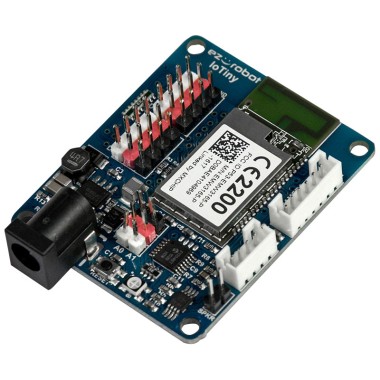
EZ-B Iotiny
by EZ-Robot
Control IoTiny with Synthiam ARC: 100MHz Cortex‑M4 Wi‑Fi IoT/robot controller-camera, servos, ADC, I2C and digital I/O for easy internet automation
Wi-Fi / USB
Servos
8
Camera
Audio
UART
✕
I2C
ADC
✕
Digital
✕
Related Robot Skills (view all robot skills)

Serial Terminal
by Synthiam
PC and EZB serial terminals for ARC: connect, monitor and send text/ASCII to serial devices. Supports COM, flow control, baud, DTR/RTS, hex

Connection Diagnostic
by Synthiam
Diagnose EZ-B Wi-Fi connection issues with verbose EZ-B communication logging, ping tests, log export and diagnostic reports for Synthiam support.
Requires ARC
v6

The iotiny datasheet (Available from the hardware page) has a block diagram showing how components are connected. It also has a section describing the led state.
Link: https://www.ez-robot.com/uploads/1/2/6/9/126941806/iotiny_datasheet.pdf
To prevent this from happening to your backup iotiny, make sure you take note of what could have happened. Do you have details of what was connected to cause it?
Thanks - that confirms the PIC is running (default fast blue blink) but the ARM never finishes boot. Given that, the ARM CPU or its power/reset circuitry is very likely not running (hardware fault more likely than simple firmware corruption).
Below I’ve laid out the next practical steps you can perform (ordered from safe/basic to advanced), exact multimeter checks, how to capture UART boot output (recap), and options for SWD/in-circuit programming if you want to go deeper. Tell me which steps you want to do and what tools you have (USBTTL adapter, multimeter, STLink/JLink), and I’ll give stepbystep instructions for that path.
Useful reference (datasheet / block diagram)
https://www.ez-robot.com/uploads/1/2/6/9/126941806/iotiny_datasheet.pdf
Next actions (choose one or more)
Capture UART boot output (confirm whether ARM prints anything) - safe, noninvasive.
Multimeter power checks (safe, simple) - check regulator and reset lines.
Look for shorts / heat (visual + measure) - safe, quick.
SWD / incircuit programming (advanced) - requires an SWD programmer (STLink / JLink) and some comfort probing pads.
Detailed steps
Preventive guidance for your backup IoTiny (to avoid repeating this)
What I need from you (next)
If you want, I’ll also provide the exact STLink/OpenOCD commands and pin mapping guidance - but only after you confirm you have an SWD programmer and can identify or paste the silkscreen near the MCU or pads.
I’ve worked quite a bit with the IoTiny - they’re robust. I just don’t remember what I did back then.
Good - since you don’t remember the exact hookup, here’s a focused list of likely failure modes (based on the IoTiny design) and practical, concrete prevention steps you can use to protect your backup IoTiny.
Quick summary of likely causes
Prevention checklist (step-by-step safe wiring & practices)
Always check voltages first
Use a dedicated, correctly rated power rail for servos/motors (recommended)
Add bulk and decoupling capacitors at the servo supply
Use proper motor/servo drivers and flyback protection
Add current limiting / fusing
Use level shifting and buffering when interfacing different voltages
Check connectors and wiring individually before power-up
Protect against voltage spikes and transients
Avoid sourcing high current from GPIO pins
Use good grounding practice
Recommended parts / modules to add (low-cost protection)
Quick "pre-flight" testing routine before connecting peripherals
Specific IoTiny guidance from the datasheet (important)
If you want, I can:
Follow-up question What peripherals do you typically connect to the IoTiny (servos: how many & voltage rating, motors, LED strips, sensors, external serial devices)? With that info I’ll give a short, exact wiring diagram and component list to protect your backup.