

KaitoMori

Garbage Data On EZ-B UART With GPS
I’m adding a small u-blox NEO-6M GPS module (TTL serial, default 9600 bps) to my EZ-Robot AdventureBot and trying to verify comms with the Serial Terminal skill. If I plug the GPS into a USB-to-TTL dongle on my Windows laptop and use Serial Terminal in PC Terminal mode (COM6, 9600, Flow Control: None), I get clean NMEA sentences every second. But when I move the same GPS over to the EZ-B v4 and switch Serial Terminal to EZ-B Terminal mode (UART on D5 TX / D6 RX, 9600, Flow Control: None), I either see random symbols or nothing at all.
Wiring details: GPS VCC to AdventureBot’s 5V on a digital port, GND to GND, GPS TX to EZ-B RX (D6), GPS RX to EZ-B TX (D5). I also tried powering the GPS from a separate 5V buck with common ground and got the same behavior. I verified baud at 9600, tried 4800/19200 just in case, and toggled the skill’s newline send options. If I keep the motors still, I sometimes see partial readable strings; if I drive the AdventureBot motors, the serial output becomes entirely garbled.
Things I’ve tried/observed:
- Swapped TX/RX to confirm crossing is correct
- Shortened the jumper leads and routed them away from the motor wires
- Added a 100 F cap across GPS VCC/GND at the module
- Confirmed the GPS talks cleanly via the PC Terminal again
Questions I’m stuck on:
- Is the EZ-B v4 UART RX pin 5V-tolerant, or do I need a resistor divider/level shifter from a 5V GPS TX?
- Any Serial Terminal skill settings I’m missing for EZ-B Terminal that affect stability (buffering, timing, CR/LF) when reading continuous streams?
- Best-practice wiring/power tips on AdventureBot to keep UART clean when the wheels are moving (caps, ferrite, separate 5V regulator, or using 3.3V instead)?
What’s the recommended way to reliably read a 9600 bps TTL GPS on the AdventureBot using the Serial Terminal skill’s EZ-B Terminal mode without getting noise or garbled data when the robot is driving?
Related Hardware (view all EZB hardware)
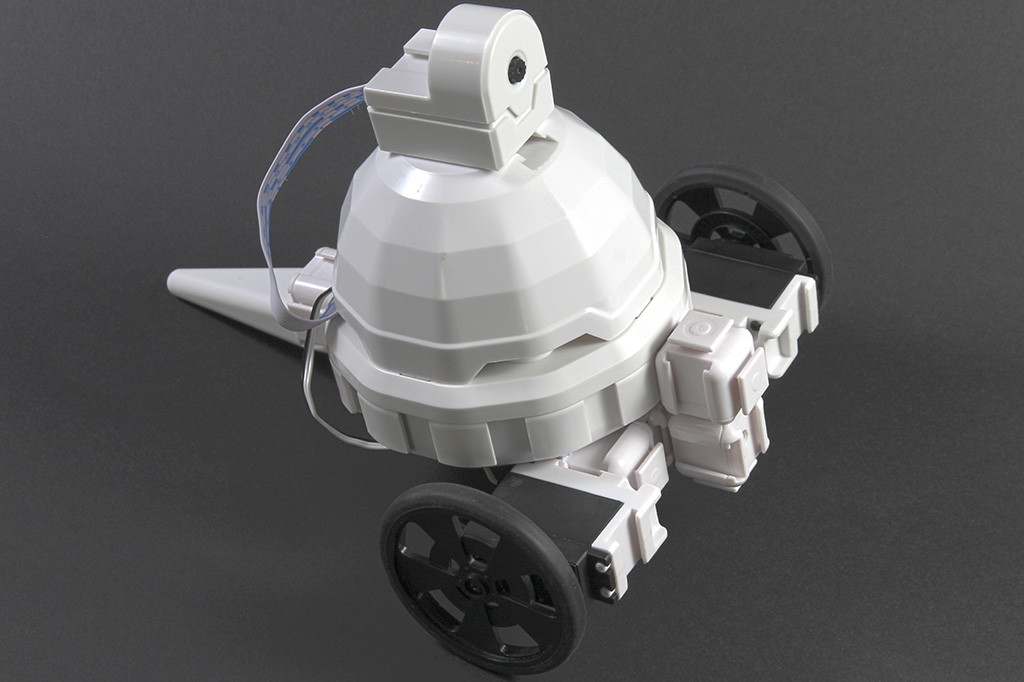
Related Robot Skills (view all robot skills)



The behavior you’re seeing usually points to signal integrity/noise, not the Serial Terminal skill itself.
A few important notes for the EZ-B v4 / AdventureBot:
1) UART level compatibility
The EZ-B v4 digital pins are 3.3V logic, so a 5V GPS TX line into EZ-B RX is not recommended.
Even if it sometimes works, it can cause unreliable reads and potential long-term issues.
Best practice:
So yes - for a 5V GPS module, level shifting is the right move.
2) Why it gets worse when the motors move
That’s a classic sign of:
Even if the GPS works on the PC USB dongle, the AdventureBot environment is noisier when the drive motors are active.
3) Serial Terminal settings
For a continuous GPS stream, there usually aren’t special Serial Terminal settings that "fix" garbling in EZ-B Terminal mode.
Things to verify:
If you want to test the UART directly, a simple ARC script using
UART.initHardwareUart()andUART.hardwareUartReadStringAvailable()is often better for debugging than the terminal view.4) Wiring / power recommendations
For the AdventureBot, I’d suggest:
5) Recommended setup
For reliability, I’d do this:
6) Best way to confirm in ARC
Try reading the raw UART data in a small script instead of only the Serial Terminal display.
Example in JavaScript:
If the data is still garbled when the motors run, that further confirms a hardware noise / level issue rather than ARC settings.
Bottom line
Most likely fix:
Helpful links
If you want, I can help you wire the NEO-6M to the AdventureBot EZ-B v4 pin-by-pin and suggest exact resistor values for a divider.