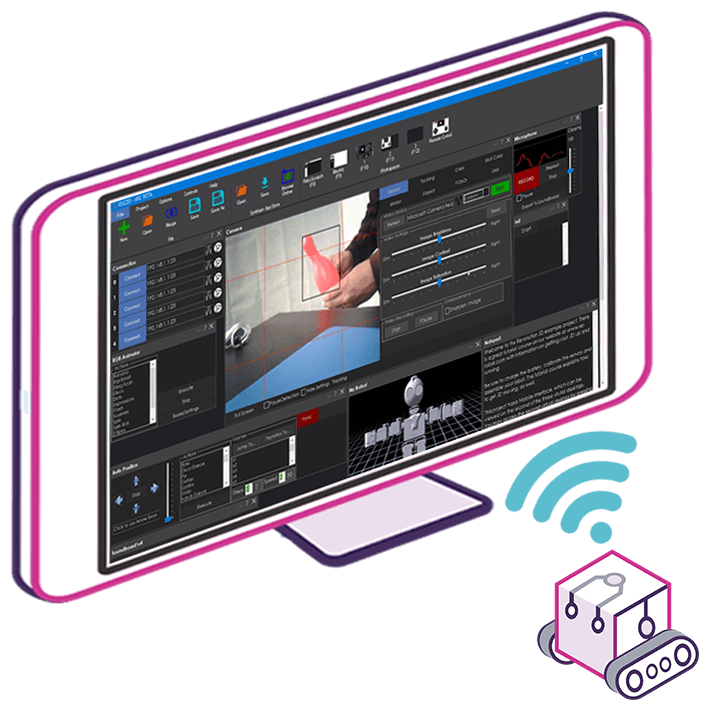
When a Servo Says 'Maybe': Uncertainty as a Feature, Not a Bug
We want robots to be sure. But the world is messy, specs are missing, and motors don’t hand out maps. Maybe the smartest move is to teach robots to shrug first, then learn.
Let’s explore why letting a robot admit “I don’t know… yet” can make it safer, more flexible, and honestly, a better roommate. Yes, even the one with 18 joints and strong opinions about coffee mugs.
Uncertainty as a Design Tool
Treat the unknown like a first-class feature. Start soft. Learn safe limits. Adapt as you go.
Smart Servos, Smarter Habits
Daisy-chained serial servos can discover themselves. IDs, baud rates, and soft stops beat guesswork.
ARC as the Sandbox
Synthiam ARC lets you experiment safely, tune live, and share what you learn with the community.
Your Robot Needs a Shrug Button
We love clear numbers. Max angle. Torque. Range. But sometimes a datasheet is late to the party, or the hardware is a mystery guest. You wire it up, ask for 180 degrees, and the servo replies with a polite whine that says, “Maybe not.”
That’s not failure. That’s a starting line. In fact, some of the most interesting builds begin with hands-on discovery. You poke gently, listen, and map the safe path. It’s like learning a new instrument: first you find which notes squeak.
Many builders have met this with smart servos that talk over serial lines. You chain them, address them, and then explore. The trick is to make the first run a conversation, not a command. Whisper first. Shout later. Your furniture will thank you.

How It Actually Works: Smart Servos, UART, and Soft Limits
Old-school hobby servos use PWM. That’s a timed pulse. Longer pulse, different angle. Smart servos add a small brain and talk over UART. UART is a simple serial link where bytes go one by one. You set a speed, called a baud rate, and both sides agree how fast to chat.
In a daisy chain, many servos share one wire. Each has an ID number. You send a packet with “Hey, ID 5, go to position 3500.” The servo’s own controller uses a PID loop to reach that spot. PID means Proportional, Integral, Derivative. Think of it like three friends steering a bike: one reacts now, one remembers the past, one predicts the future. Together, they keep the motion smooth and reduce overshoot.
Soft limits are like guard rails in software. If you don’t know true end stops, you learn safe ones, then never command beyond them. Smart servos often let you query status or at least move in small steps and watch for signs of strain. Your robot becomes cautious by default. A polite heavy-lifter is a joy.
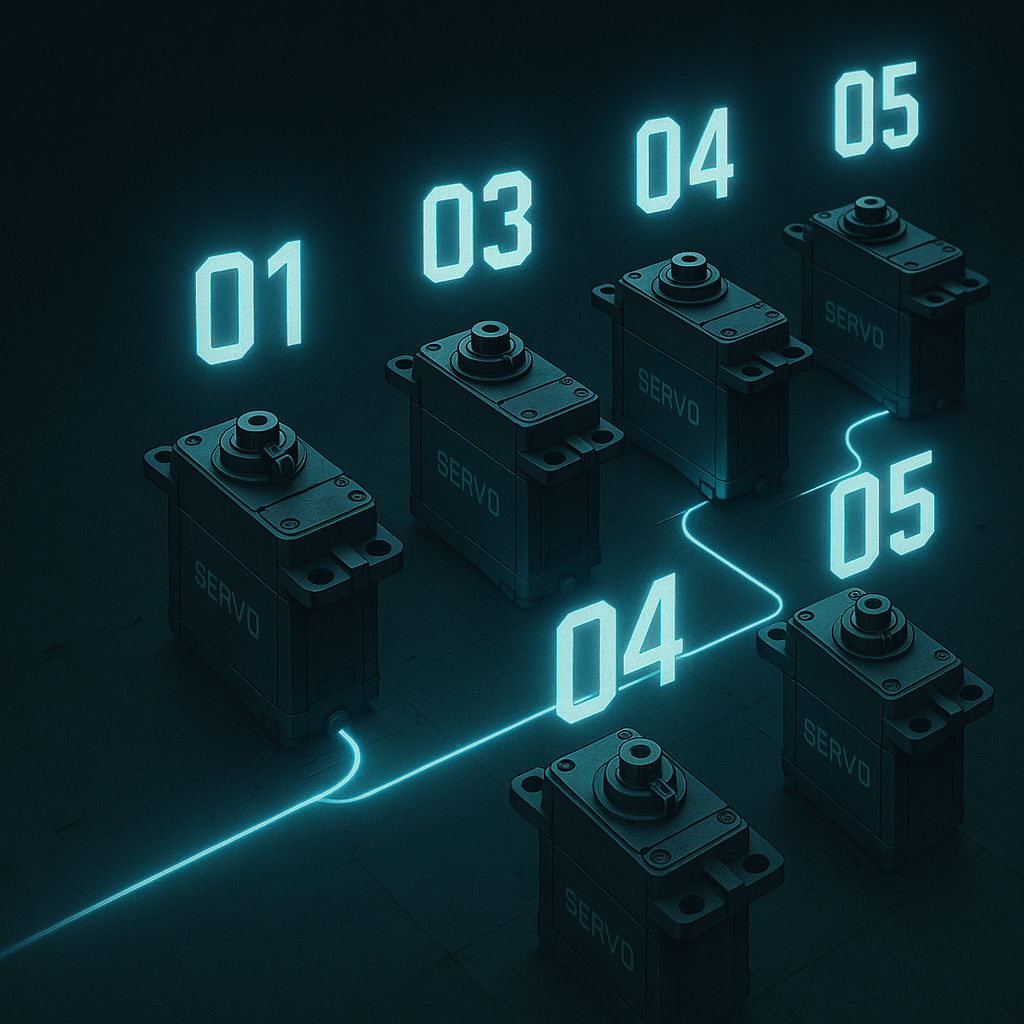
Build a "Maybe" Map: A Simple Calibration Ritual
Here’s a gentle way to learn limits without tears (yours or the robot’s). Start at a middle position. Nudge a few counts at a time. Pause between moves. Listen and watch. If current spikes, motion slows, or you hear strain, back off a little and mark that as a soft stop. Do the same on the other side. Save both numbers.
In Synthiam ARC, you can do this at startup and store the results in variables. With the Kondo KRS ICS, Dynamixel, LynxMotion, LewanSoul, and WaveShare Servo Robot Skills, you chain the servos to the EZ‑B’s UART, set the matching baud, pick the right protocol version, and then explore positions with tiny steps. If a servo offers a “release” mode, you can also let it relax when learning a neutral pose. Your robot will develop manners.

The Social Life of Unknowns
Uncertainty gets interesting when joints work together. One joint’s new soft range changes what the next joint can do. The team negotiates. This is not chaos; it’s courtesy. Your gait engine, arm planner, or animation script can read these learned limits and scale motions on the fly.
It’s also a community move. Builders trade safe ranges, ID maps, and working baud rates. One person’s “maybe” becomes another person’s “oh nice, that works.” Robots learn from us, and we learn from each other. Everyone’s code gets kinder.
A humble robot asks first, moves second, and lasts longer.

Where Synthiam Fits: Tools for the Honest Robot
Synthiam ARC is built for this kind of honest robotics. Robot Skills snap in like puzzle pieces. The experimental nature of some hardware isn’t a blocker; it’s a path. The community flagged interest in Kondo smart servos, and a Skill appeared so people could try, measure, and share. That’s the loop.
With ARC’s virtual servo ports, scripts, and live sliders, you can probe motion, set soft limits, and bake those into your behaviors. The EZ‑B hardware gives an easy UART bridge to the chain. Swap servos later? Keep your brain, change the muscles. Your robot stays curious, not brittle.
In short: uncertainty becomes a feature when the tools invite you to explore it. ARC does. And your robot becomes the kind of teammate who says, “I’m not sure… let’s find out,” then actually does.

Question: If your robot could choose between being perfectly certain or endlessly curious, which would you teach it to be?
- Unknown limits are normal—plan for them.
- Use UART smart servos with IDs for discovery.
- Set soft limits in ARC and adapt live.
- Share findings with the community.
Key Thought
Safety and agility come from small, polite moves that learn as they go. Robots can be brave and gentle at the same time.
Big Idea
Make “I don’t know yet” a first-class state in your control flow. Then give the robot tools—like ARC Robot Skills—to turn maybe into mapped reality.