
 Download ARC Free
Looking for a ROS alternative?
Short answer: Synthiam ARC is the fastest ROS alternative for most robot builders. Where ROS needs Linux, C++/Python, and days of workspace setup, ARC uses drag-and-drop robot skills for vision, speech, navigation, and AI — so you get a working robot in minutes and still drop into code whenever you want deeper control.
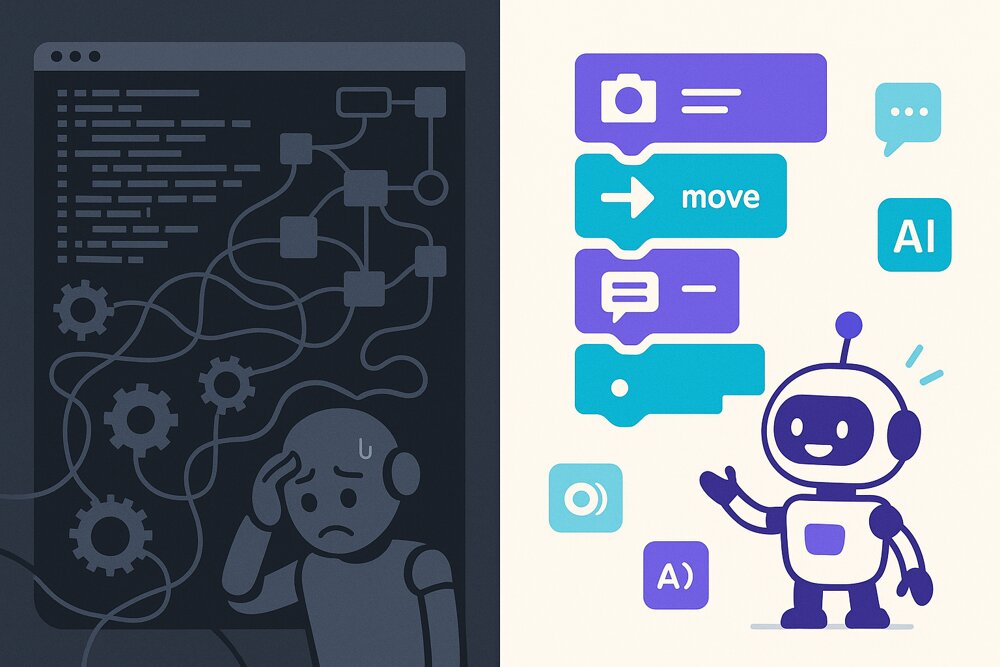
The Robot Operating System (ROS) is a research-grade middleware trusted by universities and advanced robotics labs. It is flexible and capable — but it also demands Linux, C++/Python fluency, and days of setup before your robot does anything. For most robot builders, educators, and product teams, that is a steep price to pay.
Synthiam ARC takes a different path. It is a low-code, visual robot programming platform where computer vision, speech, navigation, and AI are drag-and-drop robot skills you configure in minutes. You get results fast, without giving up the ability to script when you need to.
ARC vs ROS at a glance
| Recommended for most builders Synthiam ARC | ROS / ROS 2 | |
|---|---|---|
| Approach | Low-code, drag-and-drop skills with optional scripting | Code-first middleware and node graph |
| Programming languages | Blockly, RoboScratch, JavaScript, Python, C#, C++ | C++ and Python |
| Operating system | Windows (ARC); iOS, Android, Chromebook & macOS via ARC-Lite | Linux first; ROS 2 adds partial Windows/macOS support |
| Time to first working robot | Minutes — install, connect, add skills | Hours to days — toolchains, dependencies, workspace setup |
| Learning curve | Beginner-friendly; no middleware expertise needed | Steep; designed for engineers and researchers |
| Vision, speech & AI | Built-in, ready-to-use skills (camera, speech, LLM/AI) | Available via packages you integrate and configure |
| Hardware support | Arduino, ESP32, EZ-B, Raspberry Pi and more, out of the box | Broad hardware support through community drivers/packages |
| Ready-made content | Skill Store plus community robots, tutorials & Q&A | Large academic and research package ecosystem |
| Cost | Free edition; ARC Pro subscription for advanced features | Free and open source |
| Best for | Builders, educators, rapid prototyping & commercial products | Research labs, advanced autonomy, fully custom stacks |
Why builders choose ARC over ROS

Start in minutes, not days
No Linux setup, no build toolchains, no workspace wrangling. Install ARC on Windows, connect your controller, and start adding capabilities immediately.

See results without deep coding
Add computer vision, speech recognition, and navigation by dropping in a skill and setting a few options — then extend with scripting only where you want to.

AI is built in
Connect large language models and AI services to give your robot natural conversation and decision-making, using the AI Script Assistant to help you write robot code.

A community that ships robots
Thousands of shared projects, skills, and tutorials mean you rarely start from scratch. Browse real community robots and clone what works.
When ROS still makes sense
We think ROS is excellent for what it was built for. If you are a robotics researcher developing novel autonomy algorithms, publishing academic work, or building a fully custom Linux-based stack with specialized SLAM and motion-planning packages, ROS gives you deep control.
Many teams use both: ROS for low-level research components, and Synthiam ARC — or Exosphere for real-world robot data and human-in-the-loop AI — to move faster on the application layer and get robots into people's hands sooner.
Try the low-code alternative to ROS
Download Synthiam ARC free and connect your first robot today — no Linux, no middleware, no months of setup.
Download ARC Free Read the FAQ