
Brave robots are impressive. But they’re also the ones that dent doors, strip gears, and test your return policy.
Maybe the next big leap in robotics isn’t more force or more speed. Maybe it’s manners. Let’s teach machines to flinch—on purpose.
Flinch as a Feature
A quick back-off move protects the robot, the world, and your nerves. It’s not weakness. It’s wisdom in milliseconds.
Telemetry Creates Manners
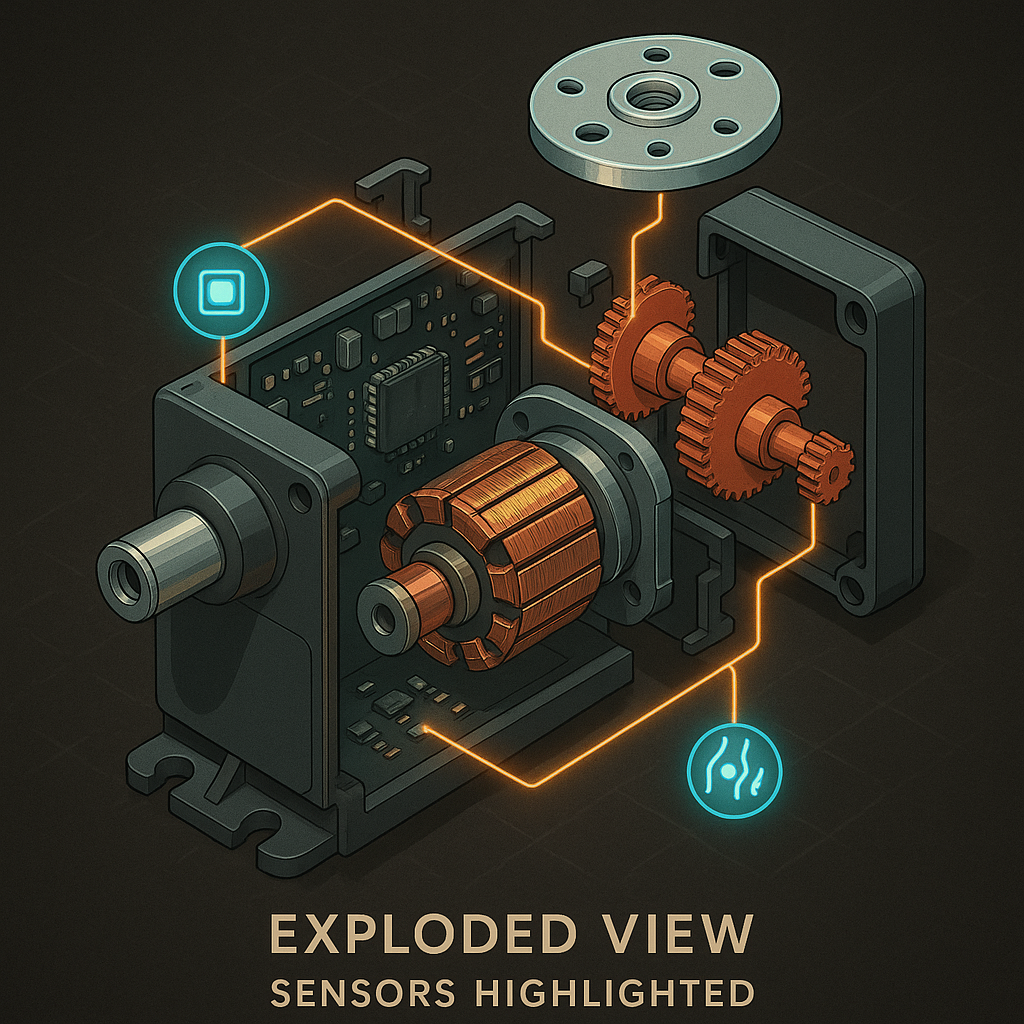
Servos that report load and heat can say, “Hey, that’s tight,” and slow down without drama.
Reflexes at the Edge
Local loops beat cloud brains for safety. Reflex first, poetry later.
The Day a Robot Learned to Flinch
Humans flinch without thinking. Your hand snaps back from a hot pan before you even say “ow.” Robots? They tend to push through. They are brave in the way a shopping cart is brave—straight, steady, and not great at reading the room.
What if your bot backed off when torque spiked, or paused to cool down, or said “after you” to a door that didn’t fully open? That tiny pause could save gears, fingers, and weekends. Polite motion beats heroic motion, especially when metal meets reality.

Quick Primer: From Dumb PWM to Smart Torque Talk
Old-school hobby servos listen to PWM. That means Pulse-Width Modulation. A control board sends a pulse 50 times a second. Short pulse, small angle. Long pulse, big angle. The servo never talks back. It’s like texting someone who only replies with thumbs-up.
Smart servos chat over UART, a simple serial link. They send data back: position, load (a stand-in for torque), and temperature. Many also run their own PID loop. PID means Proportional, Integral, Derivative. Think of it as three tiny coaches that push, nudge, and smooth the move so the arm hits the target without wobble or overshoot. Lower the P and you get softer, more “springy” motion—like adding a rubber band to the joint.
Refusal as Reliability
Good robots know when to say no. The LynxMotion Smart Servos in ARC are a neat example. They report live numbers you can use right away: the load on the joint, the direction of that load, and the temperature inside the case. If a wrist starts to strain or heat up, your script can ease off, wait, or pick a new path.
ARC exposes this as simple queries. You can ask for the servo’s temp to prevent a meltdown. You can ask load and load direction to detect a pinch or bump. With Auto Position and these readings, a 4-DOF arm can pause like a polite elevator, then continue when safe. It’s not disobedience. It’s maturity.

Tiny Reflexes Beat Big Plans
High-level brains plan. Low-level loops protect. A planner might sample paths at 10 times a second. Your joint can sense overload in 2 milliseconds. That’s the time to act. Keep the reflex local and fast—close to the motor—so the robot dodges trouble before it grows teeth.
In ARC, that means reading servo telemetry in short loops and adjusting motion right there. No cloud, no delay. Edge reflex first, global plan second. It’s like blinking—your eyes don’t wait for a committee vote.

How Synthiam Puts Manners on Motors
Synthiam ARC makes courtesy practical. Plug Lynxmotion smart servos into an EZ-B v4 UART, add the Robot Skill, and you can read position, load, and temperature while animating with Auto Position. Need to back off when GetLSSLoad spikes or cool down when GetLSSTemp rises? Easy. ARC scripting turns those readings into real behavior.
The best part: you’re not alone. The Synthiam community swaps ideas, reflex patterns, and clever safety tricks. Manners spread fast. Robots get kinder. Your shelves stay unbroken. Everyone wins—especially the shelves.
If a flinch makes a robot safer, gentler, and more trusted, what else should a machine learn to feel?

- Flinch = fast back-off on overload or heat
- Smart servos talk via UART, not just PWM
- Use load, direction, and temp to stay safe
- Edge reflexes beat delayed cloud logic
- ARC + EZ-B v4 + Robot Skills = manners
Key Thought
Strength makes motion possible. Feedback makes motion kind.
Big Idea
Design robots with a built-in “sorry.” It’s a loop, not a feeling—but it feels like trust.
