The robotics industry is approaching a historic turning point, and the companies that understand this shift early will be the ones that define the future. Based on patterns already seen in computing, software, and consumer technology, Synthiam is positioned exactly where the market is heading.
This is not a speculative fantasy. It is a repeatable technology pattern: first the experts control the tools, then middleware simplifies development, and finally natural interaction opens the door to everyone. Robotics is now moving through that same progression.
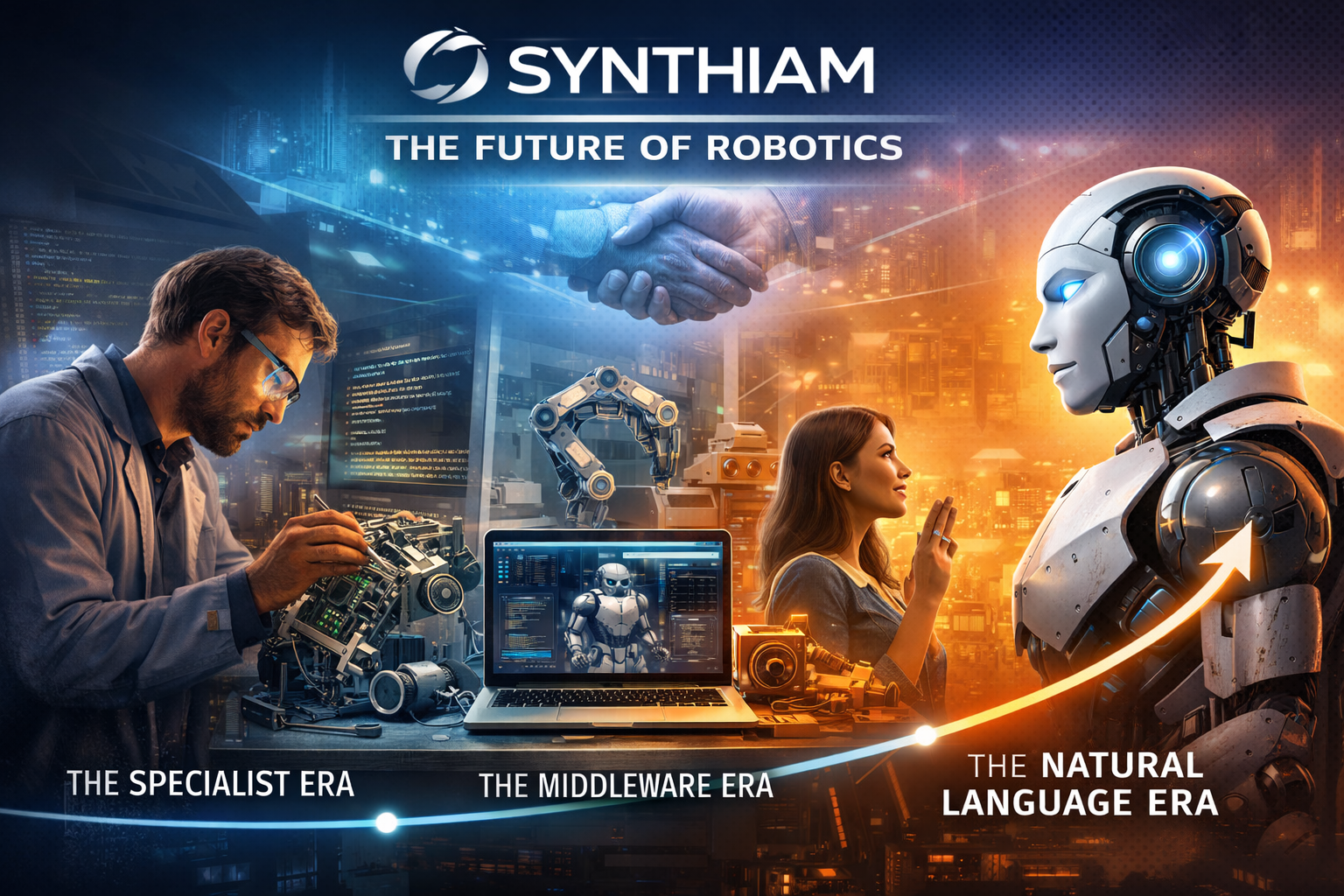
Specialist Era
Only highly trained experts can build and operate the technology successfully.
Middleware Era
Platforms and frameworks make development easier, but technical skill is still required.
Natural Language Era
People simply state what they want, and the system handles the technical execution automatically.
We’ve Seen This Movie Before
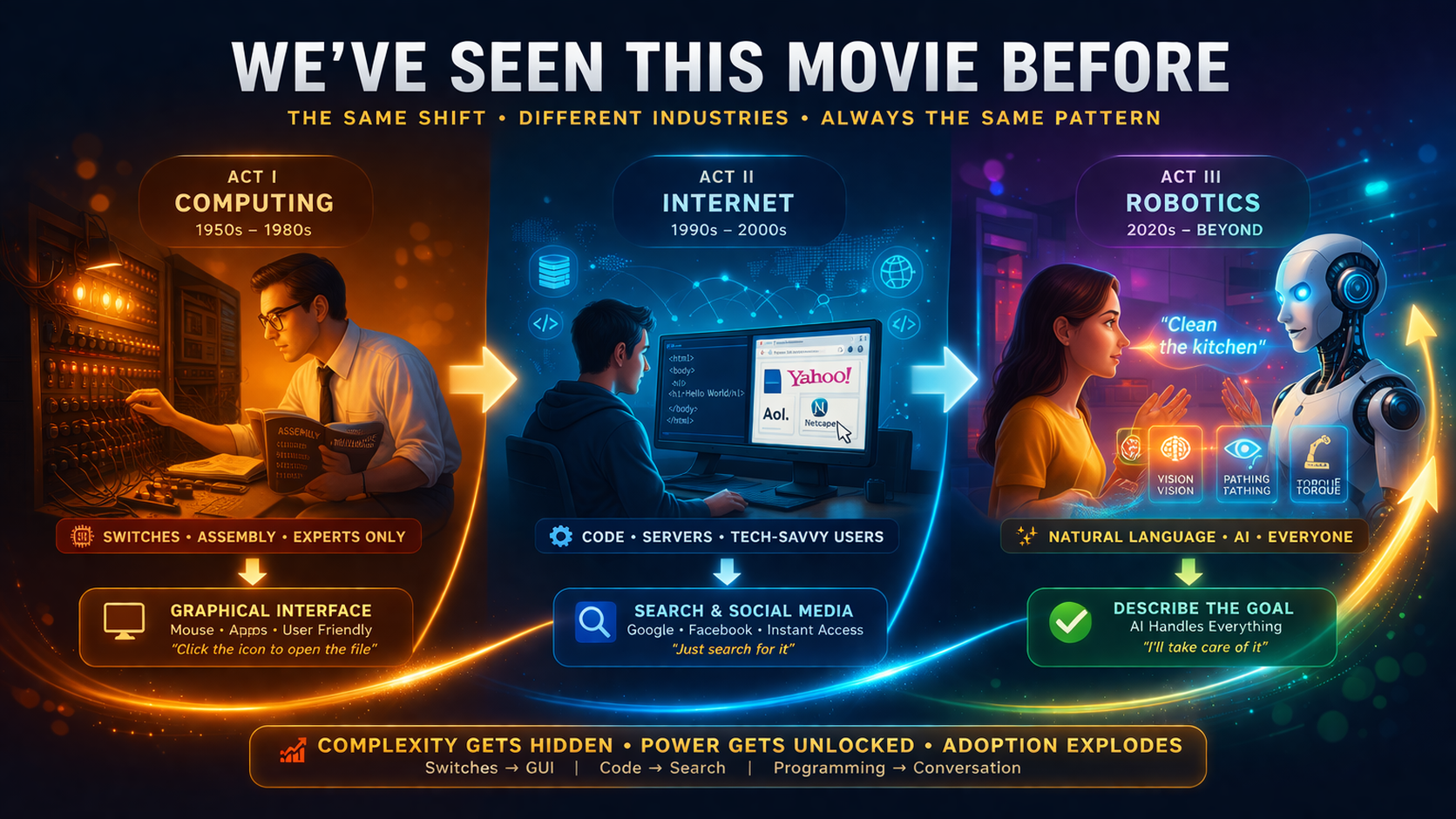
The strongest argument for Synthiam’s future is not just what robotics could become. It is what other industries already became when they reached the same inflection point.
In the early days of computing, using a machine required deep technical knowledge. Users interacted with hardware directly, toggled switches, entered commands manually, and often worked in assembly or highly technical programming languages. The computer was powerful, but the barrier to entry was enormous.
Then came abstraction. Operating systems, higher-level languages, user interfaces, and application platforms transformed computing from something only specialists could use into something ordinary people depended on every day. The winners of those eras were rarely the companies that stayed closest to the hardware. The winners were the ones that made power accessible.
Fun Fact
Every major technology wave eventually moves away from low-level control and toward high-level intent. The interface becomes more human, and adoption accelerates.
Robotics has been slower to make this leap because robots do not live in clean digital environments. They operate in the physical world, where objects move, lighting changes, surfaces vary, hardware fails, and real-world uncertainty creates endless edge cases. For decades, this messiness kept robotics in the hands of specialists.
But that old limitation is no longer the same obstacle it once was. Artificial intelligence is changing the equation.
The Three Stages of Robotics Evolution
The evolution of robotics can be understood through three clear stages. This framework helps explain why Synthiam’s strategy aligns so closely with where the industry is headed.
The Specialist Era
In the first stage, robotics belongs mostly to highly trained engineers, researchers, and technical institutions. Success depends on expertise in electronics, embedded programming, kinematics, pathing, sensors, and countless low-level implementation details. This is where robotics spent many years. Progress existed, but adoption remained narrow.
The Middleware Era
In the second stage, tools emerge to simplify development. Frameworks, visual interfaces, reusable robot skills, and integration platforms reduce the complexity of building robotic behavior. This is the era where platforms such as ARC play an important role. Middleware does not eliminate technical work, but it dramatically lowers the barrier to creating meaningful results.
The Natural Language Era
In the third stage, the interaction model changes entirely. Instead of programming every detail, the user communicates intent. They say what outcome they want, and the system determines how to achieve it. Commands such as “clean the kitchen,” “follow that person,” or “inspect this area” become realistic because AI bridges the gap between a human goal and the robot’s technical execution.
Why the Timing Matters Right Now
Many people still think robotics is permanently difficult because that has been true for so long. They assume every useful behavior must still be designed manually, tested manually, corrected manually, and supported by thousands of lines of code written for specific situations.
That assumption is rapidly becoming outdated. Generative AI and large reasoning models are already proving that machines can translate human instruction into structured logic, break complex tasks into smaller actions, interpret context, and adapt dynamically. In other words, the logic bridge that once kept robotics locked in the specialist era is finally being built.
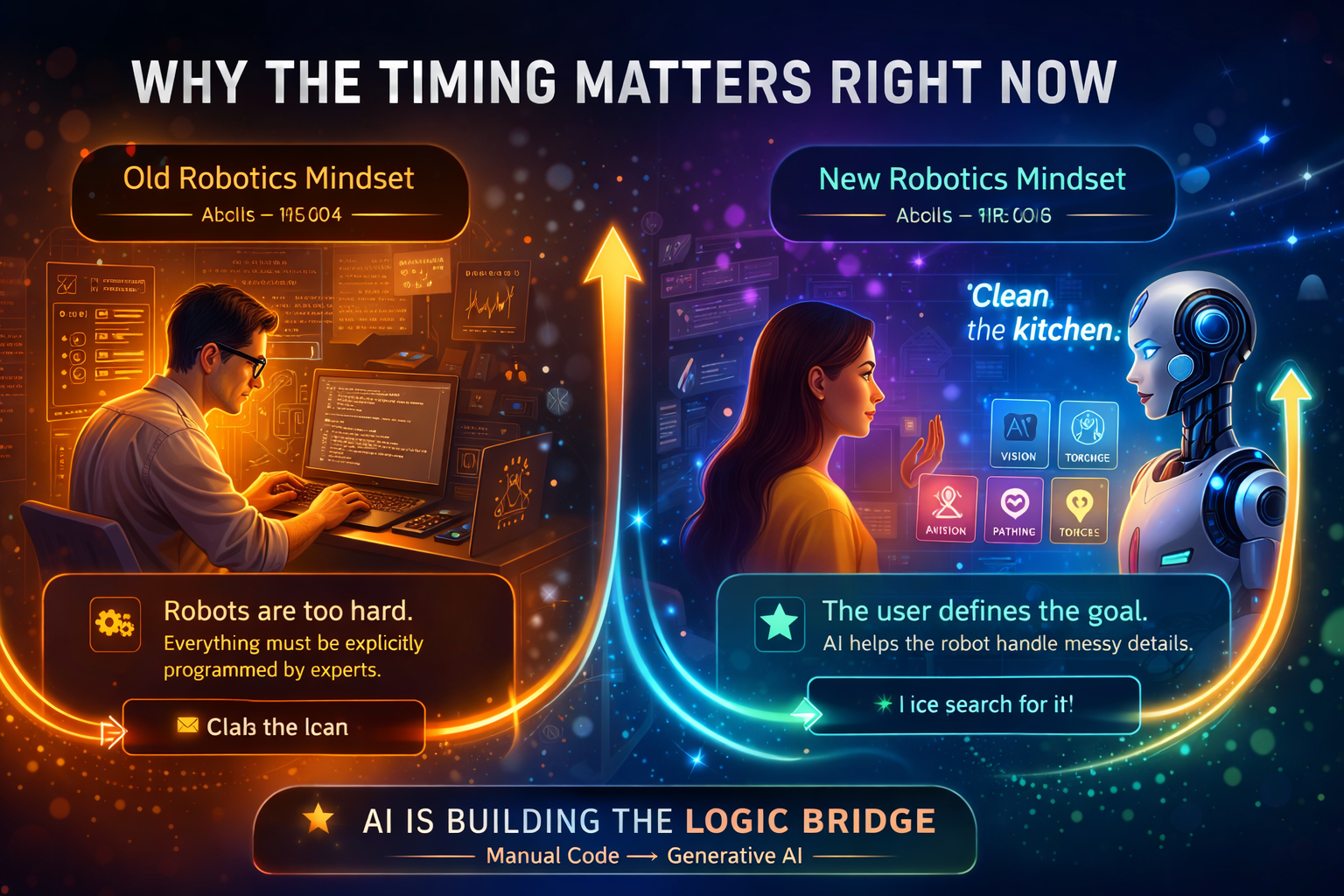
Old Robotics Mindset
“Robots are too hard. Everything must be explicitly programmed by experts.”
New Robotics Mindset
“The user defines the goal. AI helps the robot handle the messy details.”
That is why this moment feels so important. The industry is not waiting for the future anymore. It is actively crossing from stage two into stage three.
Why Synthiam Stands Out
Synthiam’s strength is that it has not built its platform around the assumption that only robotics experts matter. Instead, it has consistently invested in making robotics more approachable, more modular, and more outcome-driven. That matters because the companies best positioned for the natural language era are not the ones that worship complexity. They are the ones that know how to convert complexity into usability.
ARC is an example of that philosophy in action. It serves as a bridge between hardware capability and human intent. It reduces the amount of low-level work required to create sophisticated robot behaviors, while still allowing advanced users to go deeper when necessary. That balance is exactly what a transition platform should do.
Bubble Insight
The companies that lead the next era of robotics will not be the ones that make users think like engineers. They will be the ones that let users think like users.
This is why Synthiam has such a strong strategic position. It already understands the importance of abstraction, rapid development, accessible interfaces, reusable skills, and practical results. Those are not side benefits. They are core requirements for mainstream robotics adoption.
- Accessible workflow: Lowers the barrier to building robot behavior.
- Flexible platform design: Supports experimentation, iteration, and scale.
- AI-ready direction: Aligns naturally with natural language and intent-based control.
- User-focused philosophy: Prioritizes outcomes instead of forcing low-level implementation.
The Quiet Revolution Becomes Obvious
Some industry shifts arrive with loud headlines. Others build quietly until they suddenly appear inevitable in hindsight. Robotics may be in the second category. Right now, many people still view robots through the lens of yesterday’s difficulty. They have not yet adjusted to the reality that AI is rapidly rewriting what is practical.
When the transition becomes obvious to the broader market, the advantage will belong to the companies that spent years building the right foundation. Synthiam appears to be one of those companies.
The long-term destination is clear: users will increasingly interact with robots in plain language, define goals instead of procedures, and expect intelligent systems to handle planning, object recognition, motion, and adaptation automatically. As that expectation spreads, platforms designed around usability and intelligent abstraction will move from helpful to essential.
At a Glance
Past: Robotics required specialists.
Present: Middleware platforms reduce complexity.
Future: Natural language becomes the interface.
Opportunity: Synthiam is aligned with that future now.
Bubble Thought
The real breakthrough in robotics is not just better hardware. It is better interaction between humans and machines.
Why Adoption Accelerates
- Lower learning curve
- Faster deployment
- Broader audience
- Higher commercial value
- More practical outcomes
The Big Idea
The future of robotics belongs to platforms that hide complexity and empower people.